THE SQUARE THAT DID NOT APPLAUD
God is dead. God is dead.
This is not a phrase meant to shock the reader — it is a diagnosis that someone needed ten years of silence on a mountain to utter without trembling. And yet, when he finally descended to speak it aloud, the square laughed. Not because the phrase was absurd. But because the square was not yet hungry for it. The square wanted the tightrope walker. It wanted the usual spectacle, the rope stretched between two towers, the calculated and applaudable risk. No one there had asked for a truth that demanded rebuilding, alone, everything that had once come ready-made from somewhere outside oneself.
There is something about this scene that no one usually looks at directly: the man was not ridiculed for being wrong. He was ridiculed for being too early for that audience. And that is, perhaps, the most peculiar solitude there is — not that of the one who speaks and is not heard, but that of the one who speaks exactly the right truth, in the right place, to people who are not yet ready to need it.
You have felt this. You don’t need to have descended any mountain. You just need to have arrived home, after a process of internal turnaround — a grief that resolved itself in a way no one expected, a professional decision that broke with everything your family always validated, a new way of loving that doesn’t fit into the categories they learned to offer you — and to have noticed, on the face of those who listened, that same laugh disguised as affection. How good that you’re fine. But isn’t it too soon to change that much? It is the square, again, waiting for the usual tightrope walker.
The question this raises is not whether the truth is worth it. It is whether it is worth bringing truth to a place that did not ask for it.
And here lies the first trap for those who decide to live with more consciousness: the expectation that depth, once achieved, will be automatically recognized. It will not. Inner maturity does not come with subtitles. No one sees your ten-year process — they only see the five minutes in which you descend and speak differently than you used to. And those five minutes, isolated, look like madness, exaggeration, a phase, a crisis. The square has no access to the mountain. It only has access to what you say once you’ve already descended — and it judges by the surface, because that’s all that is available for it to judge.
This changes the question normally asked about living with truth. The question is not “will people understand?” It is: “do I descend even knowing they might not understand?” And it is precisely here that most people retreat. Not because they are afraid of the truth they carry — but because they are afraid of the silence that comes after speaking it. The silence of one who expected applause and received indifference. The silence that seems to confirm that perhaps the truth wasn’t so important after all, since no one seemed to need it.
But even before reaching the square, there is a smaller, more treacherous mountain that almost no one climbs: the mountain of admitting, without looking away, that there is nothing ready waiting for you inside. No fixed nature. No “I’ve always been this way” that explains and justifies, once and for all, what one does with one’s own life. What exists at the center of every person is an opening — a bottomless space where each instant holds a new choice, and no previous choice has the power to decide the next one. This opening is, at the same time, the closest thing to freedom one can have, and the hardest thing to sustain while looking straight at it. Because if nothing is ready, then everything — absolutely everything one does, feels, avoids — is choice. And choice implies responsibility without discounts, without any excuse that holds up to the end.
That is why so many people prefer not to look at this opening. They prefer to hastily invent anything that seems ready: a childhood that explains everything, a zodiac sign, a diagnosis used as a sentence, a “personality” treated as an unchangeable destiny. These are different forms of the same flight — the flight of transforming one’s terrifying freedom into a script already written, one that no longer needs to be decided, only repeated. And when the ready-made script doesn’t even convince oneself, the second layer of flight arrives, even more sophisticated: I justifying me, who justifies me, who justifies me again — a succession of versions of oneself, each created only to explain the previous one, none willing to stop and simply admit what is being felt, without disguise, without a third party to blame, without contempt to distribute in order to alleviate the weight of having chosen.
This flight rarely comes from ignorance. It comes from knowing — or from having, right there, all the conditions to know — and preferring not to listen. Preferring to justify rather than feel. Preferring to blame rather than exist without anesthesia. Because the naked truth — that there is nothing beyond one’s own choice sustaining every gesture of life — is too dizzying to keep in sight at all times. And that is precisely why descending the symbolic mountain to speak an uncomfortable truth begins long before the square — it begins in the instant when someone stops fleeing from themselves enough to finally have something true, and not borrowed, to say.
But mistaking that silence for proof of error is the first deception. The silence of the square does not measure the value of what was said. It only measures the distance between the one who speaks and those who have not yet arrived there. These are completely different things, and confusing them is what makes so many people return to the mountain in retreat — not to mature further, but to hide, thinking the problem was having descended too soon, when in truth the problem was expecting the square to be at the same point as the mountain.
The retreat often comes disguised as wisdom. The person says to themselves: “I will no longer waste truth on those who are not ready,” and this sounds mature, sounds like hard-won discernment. But one must distrust this phrase when it appears right after a laugh that hurt. Because there is a huge difference between choosing silence out of wisdom — knowing exactly when and where the word will be seed, not waste — and choosing silence out of wound, closing the door on the entire square just because a specific audience, on a specific day, didn’t know what to do with what was offered. The first is strategy. The second is fear wearing strategy’s clothing so it doesn’t have to recognize itself as fear.
The test to differentiate one from the other is simple, though uncomfortable: wisdom chooses silence and remains available for the next square, the next person, the next opportunity to descend. Fear chooses silence and begins to avoid squares — any square, all squares, anticipating the laugh even before knowing if it will happen again. When retreat becomes habit, and not an occasional exception, it is a sign that the mountain has ceased to be a place of elaboration and has become a hiding place. And a hiding place, no matter how high and silent, produces no more maturation — only more and more reasons to never descend again.
There is an even more uncomfortable question hidden within all of this, and it is the one you brought: is it worth living what we set out to live, if one day, in the end, nothing will remain? If the square never applauds, if no one understands, if all of this ends and the universe continues exactly as it would have continued without you having descended at all — was it worth it?
Most of the answers out there try to resolve this question by inflating meaning: they say yes, it was worth it, because you leave a legacy, because someone will remember, because the impact continues after you are no longer there to see it. These are beautiful answers. And they are, all of them, a sophisticated way of fleeing the question — because they remain dependent on a future audience to justify the present. They trade today’s square for tomorrow’s square, but remain tied to the same logic: I need someone, at some point, to validate this, or it wasn’t worth it.
There is another possibility, harder to swallow and more honest: the question “is it worth it, if in the end nothing remains?” is formulated backward. It assumes that the value of an action must be proven by a subsequent result — an audience that applauds, a memory that persists, an effect that propagates. But what if the value is not afterward? What if it is entirely contained in the instant the action happens, without needing any witness to be real?
Think of the man in the square empty of laughs. In the exact moment he speaks — before knowing they will laugh, before any result — something has already happened that no subsequent reaction can undo. He has already become, in that instant, someone who said what needed to be said, even without guarantee of being heard. This is already an accomplished fact. The laugh that comes after does not erase this — it only reveals that the square was not yet ready. But the act, in itself, had already happened whole, complete, before any external judgment arrived to validate or destroy it.
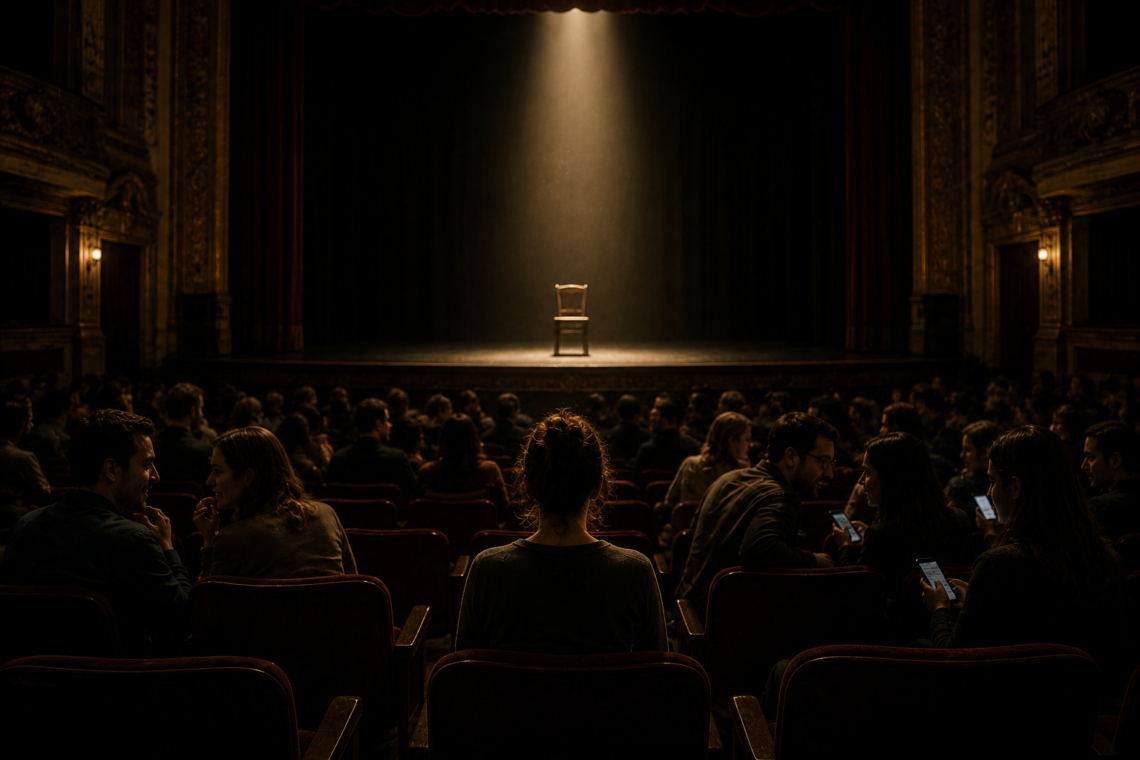
That is why the question “is it really worth it, when nothing exists?” carries an error of chronology. It places “nothing exists” in the future, as if it were the final verdict that will decide, retroactively, whether the entire life made sense. But “nothing exists” is not a verdict — it is only the end of the stage. And confusing the end of the stage with the judgment of the play is the oldest mistake there is. No one asks, after the theater lights go out and everyone leaves, whether the play “was worth it” based on how long the room stayed empty afterward. The play already happened. It already was, entirely, what it was, while it was being performed.
It is worth stretching this image a little further, because it is where the most subtle deception resides. When someone asks “is it worth it, if one day nothing will remain?”, they are implicitly comparing two states: the state of having lived intensely, and the state of no longer existing. And they are weighing one against the other, as if they were things of the same nature, placeable on the same scale. But they are not. Living with wholeness is a verb — it is something that happens, that has texture, duration, weight, present. No longer existing is not a verb. It is the absence of any verb. Comparing the two is like asking if the taste of a fruit “is worth it,” considering that one day the fruit will rot. The question confuses two categories that could never cancel each other out: the taste happened while the fruit existed, and no subsequent decomposition has the power to go back in time and undo the taste that was already felt.
The same applies to every instant in which you truly lived — not survived, not sketched, not waited for the right moment, but lived, fully, what you had to live in that specific moment. That instant is not in debt to the future. It does not need to be redeemed by anything that comes after, nor does it need to fear being annulled by anything that comes after. It simply was. And “having been,” in a full and true way, is a category that no future erasure can reach, because future erasure only acts on what is yet to happen — never on what has already, in fact, occurred.
Only here lies an essential difference between theater and life: in theater, someone bought a ticket, sat down, watched. In life, sometimes you step onto the stage and the room is empty from the start — or worse, it is full of people who came to see something else, and they laugh when you don’t deliver the expected spectacle. And even so — even without an audience, even with laughter in place of applause — the question of whether it was worth it cannot depend on who was in the seats. It must depend on one thing only: whether you, on that stage, were entirely yourself while the light was on.
This is not cheap consolation for those who failed to be heard. It is a radical shift in where the criterion of value is placed. As long as the criterion is in the audience — applauded, understood, validated, remembered — you are condemned to live on loan, asking every person around you for permission they never had real authority to grant. When the criterion shifts to within the act itself — I said what needed to be said, I lived what was mine to live, I descended when I needed to descend, even knowing no one was ready — the question about “nothing that will remain” loses its urgency. Because nothing needs to remain for something to have already been, entirely, real.
Some confuse this with indifference to the world, as if it were enough to do things “for oneself” and that’s it, with no responsibility for the effect one causes on others. That is not what this is about. Descending the mountain continues to be a generous gesture — you descend because you have something to offer, not because you want to be alone speaking into the void. The generosity of the gesture does not disappear. What disappears is the dependence on that generosity being received the way you imagined, at the moment you imagined, by the person you expected to receive it. You can continue offering truth, presence, depth — without making the square’s response the thermometer of your value.
And perhaps that is exactly what separates those who truly live from those who only perform authenticity: the willingness to keep descending, even after having been received with laughter, because the descent was never, from the start, about getting the applause. It was about being, integrally, who you are, at the moment you are. Applause, when it comes, is a generous bonus. Its absence does not invalidate anything that truly happened inside.
There is still a distinction worth naming, because without it, it is easy to confuse courage with isolation. Climbing the mountain to elaborate, in silence, what is not yet mature enough to be spoken — that is fertile solitude. It is the kind of withdrawal that prepares someone to descend more whole than they climbed. But there is another kind of silence, which only looks the same from the outside: the isolation that justifies itself as elaboration, but in practice is flight from any square, any judgment, any chance of laughter. Those in fertile solitude feel the impulse to descend when the cup fills — they feel they have something to offer, and the generosity of offering weighs more than the fear of reaction. Those in isolation feel the opposite: every reason to descend is immediately overcome by a greater reason to keep climbing, always postponing, always finding a new reason to wait a little longer before exposing themselves again. The mountain, in this second case, ceases to be preparation and becomes a permanent destination — a place beautiful enough to seem like a conscious choice, but which in truth is only fear with a panoramic view.
So return to the original question, but turn it inside out: do not ask whether it is worth living, fearing that one day nothing will remain. Ask whether, while it remains, you are being whole in what you do. Because the day when nothing more exists will ask nothing of anyone. It will simply arrive — silent, without an audience, without a verdict, without applause and without laughter. And on that day, the only thing that matters will not be how long the square stayed full or empty. It will be whether, while you were in it, you spoke — or waited for a permission that would never come, hoping that one day the right crowd would finally be ready to hear you.
The mountain will always be there, available for those who want to return and hide in it after a laugh that is hard to swallow. But the question that remains is not about the mountain. It is about how many times you are willing to descend, even knowing, in advance, that the square may not be ready — and descend anyway, not because you will be applauded, but because that, and only that, is what it means to have truly been alive while it lasted.
And perhaps now, only now, the phrase that opened this text can be heard without the shock of those who think something died out there, in some sky, distant from everything lived in here. God did not die first and then leave a void. It was the opposite: the void was always there — this bottomless opening at the center of every person, this space where nothing comes ready and everything must be decided anew at every instant — and it was this void, seen face to face, without looking away, that made it impossible to continue believing that there existed, somewhere outside oneself, a figure complete enough to decide, in one’s place, what is worth it. The phrase does not announce a loss. It announces a recognition: that the nothing which was always here inside never needed permission from anyone out there to be real. And that is precisely why the square may laugh, the mountain may remain empty, and even so — especially so — it is still worth it to descend.
#existentialism #couragetolive #meaningoflife #personalgrowth #selfawareness #marcellodesouza #marcellodesouzaoficial #coachingevoce
Did you enjoy this reflection? I invite you to explore hundreds of other publications on human cognitive-behavioral development, organizational development, and healthy and evolving human relationships on my blog.
Marcello de Souza | Coaching & You
marcellodesouza.com.br
© All rights reserved
Se isso fez sentido para você, existe um próximo passo possível
Algumas reflexões não terminam no conteúdo — elas continuam em forma de diálogo, aprofundamento ou sustentação de um trabalho contínuo.


LA PLAZA QUE NO APLAUDIÓ
Você pode gostar

YOU DIDN’T GET WHERE YOU ARE TO REMAIN WHO YOU’VE ALWAYS BEEN

LEADING THROUGH CRISIS OR MANAGING REACTION?