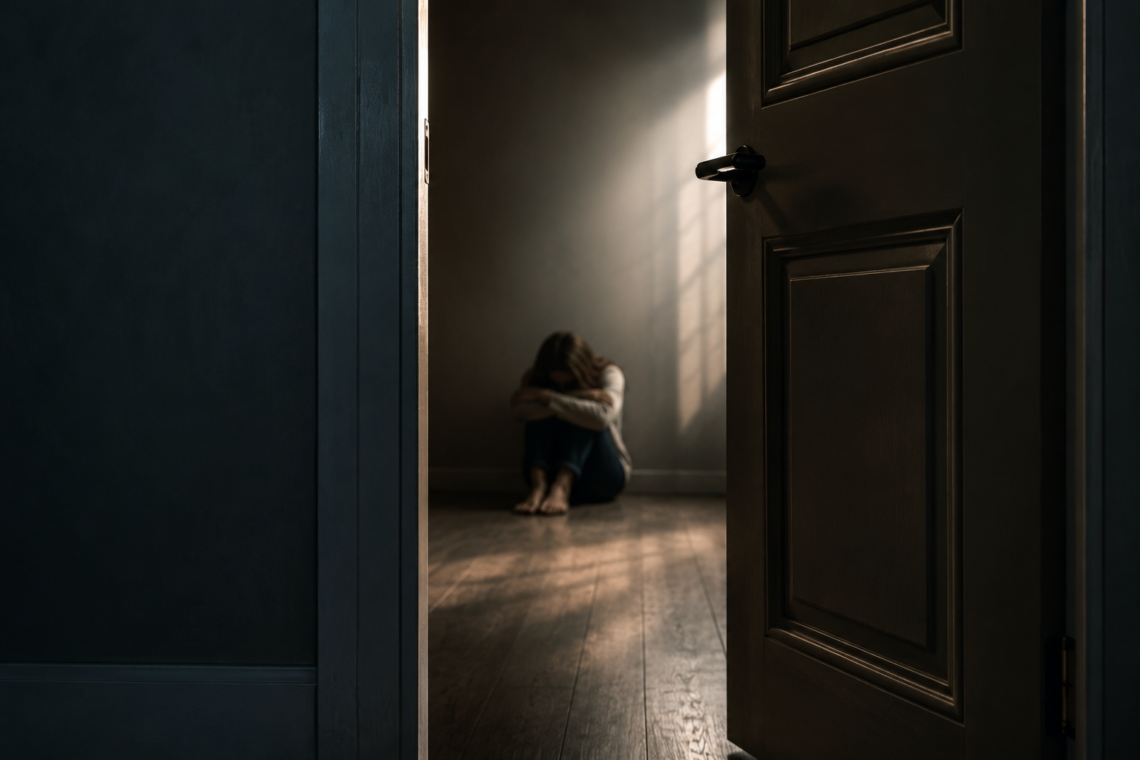
THE DOOR WITHOUT A LOCK
On the almost invisible instant when the body learns to let in those who should never have entered
Have you ever noticed that some houses have no lock on the inside doors?
Outside, everything is bolted. Gate, fence, camera, alarm. But inside, on the door to the bedroom, on the door to what is truly yours, there’s nothing. Anyone can enter. All it takes is a push.
What lies behind that unlocked door is never small. It’s what is most sacred in a person — not in the religious sense, but in the oldest sense of the word: that which cannot be negotiated, divided, or lent out. The dignity of being treated as an end, never as a means to someone else’s comfort or convenience. When that door has no guard, it isn’t just space that gets lost. It’s the sacred itself that becomes public property.
Most people who come to my practice don’t start by talking about this. They start with something else. The boss who yells and no one reacts. The husband who decides alone and only tells her afterward. The friend who calls at eleven at night assuming any hour is fair game, because at some point, without meaning to, she taught him that it was. And then, session after session, the conversation always arrives at the same place. It was never about who came in. It was about the door having been left open.
This is uncomfortable. Because the first, almost automatic reaction is to assume I’m blaming the person who was invaded for the invasion. That’s not it. Whoever crosses a line without asking is entirely responsible for what they did. That never changes, is never negotiated, has no fine print. But there’s a question that comes before that one, a question almost no one asks because it hurts more: at what exact second did the door stop being guarded?
Because every door had a guard once. A small child isn’t born handing everything over to anyone who asks. She cries, pushes, screams no before she even knows the word for it. Her body knows how to defend territory before her mouth knows how to explain why. Something happens, somewhere along the way, that teaches that body to abandon its post.
And what happens, most of the time, isn’t a visible catastrophe. It’s small. It’s repeated. It’s the dinner table where disagreeing meant a fight, so agreeing became cheaper. It’s the father whose mood set the temperature of the whole house, and the daughter learned to read that weather before she learned to read books, just to get ahead of the storm. It’s the teacher who humiliated anyone who got something wrong, and the body learned that making a mistake in public was real danger, not feedback. None of these episodes, alone, breaks anyone. Together, over years, they train an entire system to do one very specific thing: sense threat and, instead of fighting or fleeing, soften.
Soften is the right word. Smile when you should frown. Shrink when you should stand firm. Find an excuse for someone else’s behavior before you’ve even finished feeling your own discomfort. This isn’t a character flaw. It’s a survival strategy learned too early, stored in the body, triggered without consulting anyone. The body doesn’t distinguish a hostile meeting room from a savanna with a predator in it. It only knows how to repeat what worked once.
And here is the real problem with almost every popular discourse on boundaries: they teach “no” the way you’d teach a script to memorize. Ready-made phrase, calibrated tone of voice, assertiveness posture copied from a video. But no one installs a guardian by memorizing a line. A guardian installs itself by recognizing, in real time, the instant the body chooses to soften — and choosing, a second later, to do something different. That isn’t taught in a weekend workshop. That is trained, body against body, over a lifetime.
Some people confuse this with turning to stone. It isn’t. Staying open to another person, giving of yourself, truly listening — that remains beautiful, remains generosity, as long as it’s a choice. The problem was never opening up. It was opening automatically, to anyone at all, just because they shout louder or occupy a position of power. Chosen generosity and the absence of a guard look identical from the outside. From the inside, they are opposites. One nourishes. The other drains to the last drop, and still demands that the drained person smile while it happens. Because the sacred doesn’t lose its value when it’s offered by choice. It loses value when it stops being a choice and becomes a habit of invasion.
There’s a scene that repeats, with variations, in nearly every story I hear. The competent person, admired, full of visible accomplishment, sits down after yet another episode of someone walking over her without asking. And the question that comes first, almost always, is: why does this always happen to me. That question is a trap. It turns a pattern of architecture into a life sentence, as if something were permanently, definitively wrong with the person. There isn’t. There’s a door without a lock. And a lock can be installed.
The question that changes something is different. It isn’t why does this always happen to me. It’s at what second, exactly, did I let them in. Was it the silence after the tasteless joke? Was it the automatic yes when the whole body was screaming no? Was it the excuse I invented for his lateness, for her tone, for the rude way he asks for things? That question hurts more, at first. But it gives back something the other one takes away: it gives back command.
Because here is the point almost no one names correctly: you don’t control who’s going to try to come in. There will be rude people, people who think too much of themselves, people who learned, very early, that pushing works. That’s circumstance. It isn’t a verdict on your worth. What you control, with work, is whether the door will be guarded when those people arrive. Circumstance changes. The guardian, once formed, stays.
And there’s a part that’s even harder, one that discourses on “overcoming” tend to skip too quickly: most invasions never receive an apology. There’s no elegant reconciliation script for most of real life. The rude person stays rude, feeling no guilt at all, and either disappears from your path or, worse, stays in it, exactly the same, believing nothing happened.
This traps a lot of people. They wait for a recognition that never comes before allowing themselves to move on. They get stuck in a kind of emotional waiting room, ticket in hand, waiting to be called by someone who doesn’t even know they made an appointment. And time passes, and dignity remains mortgaged to a response that may never arrive.
But dignity doesn’t need authorization from the one who wounded it in order to rebuild. It recomposes itself from within, alone, precisely because it depends on no reciprocity at all. That’s harder than forgiving. Forgiving still involves the other person, somehow, even if only in imagination. Rebuilding without forgiveness, without an apology, without a closed script, is staying whole while knowing the other person may never admit what they did. It’s solitary work. And, for that very reason, more powerful.
Every time an invasion is swallowed in silence, without anything being done about it, the energy doesn’t disappear. It settles somewhere else, deformed. It becomes self-criticism where there should be legitimate anger. It becomes unexplained exhaustion where there should be a named limit. It becomes that feeling of always being one step below, without knowing why. It isn’t revenge that resolves this. It’s returning that energy in the form of declared action, of a boundary named out loud, even if the voice trembles saying it.
Watch traffic on an ordinary morning. There’s a car that honks before the light even turns green, as if the world had to move at its pace. And there’s someone in the back seat who has already learned to shrink into the seat before any honk, just from anticipating that it’s coming. The car that honks is the honking car’s problem. But the body that shrinks before the noise even arrives — that’s a reconstruction project worth starting.
Or watch the line at the bank. There are people who cut in with the ease of someone who has never doubted their own right to do it. And there are people who, even watching the cutting happen right in front of them, still spend a whole second wondering if it’s worth complaining, if it’ll make them look difficult, if the other person’s discomfort weighs more than their own right. That second of hesitation is the same second, long ago, when the door learned not to trust its own lock.
Rebuilding that second isn’t about becoming hostile. No one needs to go around picking fights with strangers in line. It’s about shortening the distance between feeling the discomfort and recognizing that it’s legitimate, without first passing through the justification room the mind builds to defend whoever invaded. That justification room, in fact, is where most of the energy gets lost. It should be judging the act. Instead it’s busy inventing excuses for the one who committed it.
There’s a way to tell whether the door is guarded or not, and it doesn’t require therapy to begin noticing: watch the time between the discomfort and the explanation. Someone says or does something disrespectful, and the body feels it before the mind decides anything. If what follows immediately is a flood of “but he must be tired,” “but she didn’t mean it that way,” “but maybe I misunderstood” — that’s softening in action, disguised as understanding. Real understanding comes after acknowledging your own discomfort, not in its place.
This doesn’t mean cutting off anyone who makes a mistake once, turning your back on every friction, living hyper-vigilant like a sentry in a war that already ended. The good guardian isn’t the one who never opens the door. It’s the one who decides, with clarity, who enters and under what conditions.
And there’s a part of this work that’s easy to forget, precisely while you’re learning to guard your own door: the other person has one too. The philosopher Emmanuel Levinas spent his life insisting on an uncomfortable idea — that there exists, in the face of every person we encounter, something that doesn’t belong to us, that resists becoming an instrument of our convenience. He called this alterity: the other as sacred, not because I decide to treat them that way, but because they always escape me, and that very escape demands responsibility from me before anything else. Guarding your own door while failing to recognize the other person’s door isn’t maturity. It’s just switching sides on the same invasion.
Sometimes the door opens on purpose, wide open, because the person on the other side deserves it. That’s generosity. The difference was never between opening or closing. It was in who decides — and in recognizing that whoever stands on the other side also decides their own door, with the same right you claim for yours.
There’s no ready-made formula for this work, no matter how much the internet tries to sell one. There’s repetition. There’s noticing, again and again, the instant the body chooses to soften, and choosing, a second later, to do something different. Once changes nothing. A hundred times starts to change everything. It’s a muscle, not a single afternoon’s insight.
There’s one place where this becomes particularly visible, and it’s at work. A team meeting, the kind where an idea is presented, interrupted, later credited to someone else, and everyone saw it, and no one said anything. The whole room participates in the same collective softening, only in a group it’s easier to justify, because there’s company in doing it. “Not the right moment,” “not worth the fight over this,” “better save your energy for the bigger battle.” Except the bigger battle never comes, because the energy that should have accumulated for it keeps leaking, meeting after meeting, in these small acts of softening that no one registers as loss.
I’ve watched entire leaderships corrode this way, with no scandal, no dramatic resignation, just a slow accumulation of doors without locks. The competent professional who accepts being interrupted constantly, who accepts getting credit only when someone remembers to give it, who accepts meetings scheduled last minute because their time, apparently, costs less than the time of whoever’s calling the meeting. It never shows up on a performance spreadsheet. But it shows up in the body, at the end of the day, in that exhaustion that doesn’t match the actual amount of work done.
And there’s another scene, this time at home. The son who learns to read his father’s mood before he learns to read his own wants. He walks into the room, gauges the temperature in under a second, decides whether to ask for what he needs or swallow it and wait for a better moment that, often, never comes. That son grows up and becomes an adult who reads every room the same way, before deciding whether to open his mouth. No one taught this on purpose. No one sat him down to teach submission. It was training, repeated, silent, efficient in the way only unconscious training knows how to be.
Reversing this requires something that sounds simple and isn’t: feeling the discomfort all the way through, before deciding what to do with it. Most people skip this step. They feel a little, then cut it off, rationalize, jump straight to the explanation that protects the other person. The discomfort barely finishes being born before it’s smothered, wrapped up, stored in a drawer that looks like emotional maturity but is, in fact, just another door without a lock — only this one hides on the inside. Feeling it all the way through isn’t drowning in emotion. It’s giving it the minimum time to exist before any borrowed justification enters the scene.
And there’s also the day the door works. It doesn’t arrive with a parade or applause. It comes quietly. Someone makes a comment that’s out of line, and this time the response arrives before the excuse. It doesn’t have to be a confrontation, doesn’t have to be a scene, it can just be an “that wasn’t okay” said in a steady voice, without apologizing for saying it. And afterward, alone, the feeling of having stayed whole in that moment, without splitting yourself between what you felt and what you were supposed to feel to please whoever was in front of you. That instant, alone, is worth more than any speech about boundaries ever written.
This isn’t about never suffering another invasion again. It will keep happening, because the world is full of people with broken locks of their own trying to get through any door they find open. The difference is response time. And the fact that every time the door holds, something settles a little more firmly inside, one more brick in a wall that didn’t exist before. No one builds a wall like that overnight. It grows brick by brick, session by session, fight avoided and fight faced, until it becomes a structure that no longer needs conscious effort to stay standing.
And maybe the question that remains, in the end, isn’t about who invaded you yesterday, last week, last year. It’s about now. About this exact instant, as you read this, feeling something that may not even have a name yet. Is the door guarded? And, just as important: do you recognize, in the face of the person in front of you, a door as sacred as your own?
“The sacred never asks permission to be respected — neither yours, nor the other’s. Whoever only guards their own door while breaking down every other one has learned nothing about the sacred. They’ve only learned to switch sides.” — Marcello de Souza
If this text touched something in you, come explore more reflections like this — on self-knowledge, conscious relationships, and human and organizational development — on my blog, where I publish original, unpublished content every week: marcellodesouza.com.br
#TheDoorWithoutALock #GuardianOfYourOwnBoundary #ConsciousBoundaries #DignityWithoutAuthorization #Alterity #ConsciousRelationships #DeepSelfKnowledge #HumanDevelopment #marcellodesouza #marcellodesouzaoficial #coachingevoce
Marcello de Souza | Coaching & Você
marcellodesouza.com.br
© All rights reserved
Se isso fez sentido para você, existe um próximo passo possível
Algumas reflexões não terminam no conteúdo — elas continuam em forma de diálogo, aprofundamento ou sustentação de um trabalho contínuo.


LA PUERTA SIN CERRADURA
Você pode gostar

REWRITING THE PAST TO BUILD THE FUTURE
The Perfect Union: Preparation, Opportunity, and Luck
