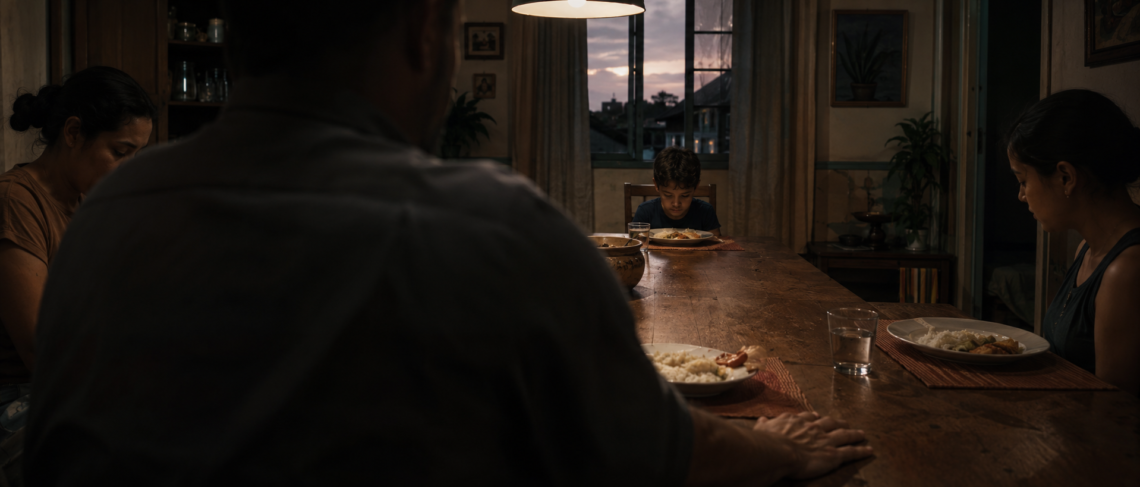
THE DICTATORSHIP THAT FITS ON A DINNER TABLE
There’s a question I ask, every now and then, to whoever sits across from me ready to actually look at themselves: who was the first person to give you orders?
I’m not fishing for the name of a strict teacher, or a difficult boss. I ask, and I wait. Because almost every time, after a silence that says more than any answer could, the person travels back to a table. A dinner table, a couch in the living room, a car stopped at a red light while someone up front is yelling. And right there, in that small, domestic scene, is the first regime that person ever knew.
Nobody is born knowing how to obey. Obedience is taught. And the first teacher wears no uniform, gives no speeches, waves no flag. It shows up as a lap to sit on, food on the table, the phrase “because I said so” repeated until it becomes law.
I think about this a lot when I see someone defend, with a conviction that borders on affection, a public figure who openly despises the very group that person belongs to. The woman who cheers for someone who belittles her. The worker who wears the jersey of the one exploiting him. Everyone calls this a contradiction, a miscalculation, a failure of information. I don’t. I call it memory.
Because there’s a strange thing we do that nobody ever taught us to name: we confuse what’s familiar with what’s safe. And family, here, isn’t just yours. It’s the shape. The structure. That particular way of loving mixed with control, that “this is for your own good” that shuts a child’s mouth before she even finishes forming the thought.
When this repeats for years, something settles inside a person that I call, with no pretension at all, an invisible architecture. A map of how power behaves, how affection gets conditioned, who speaks first and who lowers their head. And that map, once drawn, doesn’t stay locked in some childhood drawer. It walks out into the world. It shows up in dating. It shows up at work. It shows up, yes, in the voting booth.
I’ve watched sharp, capable people — able to argue economics with real command, able to debate social justice for hours — choose leaders who reproduce, point for point, the father they had. Or his absence. Or the mother who only loved them back when they obeyed. And they don’t see it. Because whoever is standing inside the map can’t see the map. All they feel is that it’s familiar. And familiar, to the body, sounds like safe, even when it isn’t.
I keep thinking about the line at the bank. That banal, irritating scene where someone cuts in and nobody reacts. People grumble under their breath, trade looks of quiet indignation, and do nothing. And if a stranger asked why nobody spoke up, the honest answer would probably be: because back home, disagreeing meant a fight. Disagreeing had a cost. So better to swallow it.
Notice how this is exactly the same mechanism, just on a bigger scale, when an entire country swallows. When a country watches things happen, feels the discomfort, feels the quiet indignation, and still doesn’t confront it. Maybe because, collectively, we also learned that questioning whoever’s in charge has a cost. That it can cost love, belonging, your seat at the table.
This isn’t an excuse. I’m not opening up some comfortable alibi that says “it’s childhood’s fault.” It isn’t. Blame, when there’s a conscious adult choice involved, belongs to whoever chooses. But there’s a huge difference between blame and origin. And pretending origin doesn’t matter is just a sophisticated way of continuing to repeat it.
One thing I’ve learned, listening to hundreds of stories over the years, is that authoritarianism doesn’t arrive full-grown. It’s born small, domestic, disguised as care. It’s born in “I know what’s best for you,” in the silence a child learns to keep so she doesn’t get hurt some other way, in the idea that love and control are the same thing wearing different clothes.
And then, when that person grows up and sees, out in public life, a figure promising order at the cost of freedom, something very old inside them recognizes it. Not as a threat. As home.
Some of you reading this will think: but I had a calm childhood, my parents were kind, and I still find myself drawn to harsh rhetoric. I get it. Because kindness can come with conditions too. There’s a kindness that only shows up when you behave the way you’re expected to. And that, to the body, is still a form of regime. Just with a softer aesthetic.
This isn’t about pointing fingers at parents. Most of them did what they knew how to do, with the tools they had, inside their own inherited map. This is a chain. One that runs through generations without asking permission. And the only way to break a chain is for someone, somewhere along it, to decide to actually look at it.
That kind of looking hurts. I know because I’ve done that work on myself, more than once, at different points in my life, each time uncovering a layer I could have sworn I’d already dealt with. And every time I really looked, I found the same thing: a boy who learned, too early, that love had a price, and that the price was disappearing a little to fit what everyone else expected.
How many elections, how many relationships, how many career choices do we make trying, without realizing it, to recreate that disappearing act? Choosing bosses who yell because yelling was normal at home. Choosing partners who control because control, for us, always looked like care. Choosing, in the collective arena, whoever promises to force order, because disorder, back at the source, meant danger.
I don’t have a tidy formula for breaking this. Nobody does, and I’m suspicious of anyone who promises a solution in three steps. What I have is a question — the same one I ask in session — and I’m handing it back now to whoever is reading.
There’s a detail I notice often that almost nobody catches: the way a person handles disagreement at home today, as an adult, tends to be an exact portrait of what she lived through when disagreeing wasn’t allowed. Whoever grew up in a home where questioning meant disrespect now treats any question, from any direction, as an attack. And the ability to hear plain difference of opinion for what it is disappears, because the body already learned, back then, that a difference of opinion was expensive.
That explains something that has always intrigued me. Why do political arguments turn into war between relatives who otherwise get along fine? It’s not about the topic. It’s the old shape reappearing. It’s that son who, at eight, learned that disagreeing with his father at the table brought punishment, and who now, at forty, disagrees with his cousin in the family group chat and feels the same cold drop in his stomach he felt as a boy. The argument looks like it’s about taxes, about public safety, about who should govern. Underneath all of it, the body is right back at that table.
And here’s a layer that rarely gets the seriousness it deserves: a system trained to recognize old danger fires off just as easily at anything similar, decades later, in a completely different context. A voice that rises in just the right way, a hand gesture that echoes someone who once hurt you, a promise of protection that sounds exactly like the one that always came bundled with control — all of it triggers, without asking permission, a response that was already loaded long before that person ever encountered politics. Politics, in that sense, doesn’t create submission. It just finds ground already plowed.
There’s another thing I need to say, because staying quiet about it would be dishonest: there’s also the reverse road, and it’s just as loaded with repetition. Some people grew up in a rigid home and responded by embracing any rhetoric that promised the opposite of what they lived, without ever checking whether that opposite actually made sense or was just relieving an old wound. Automatic rebellion is just as much a repetition as automatic obedience. Both come from the same place: the inability to choose from who you are, instead of choosing from the wound.
I tend to tell people going through a season of rebuilding that there’s a huge difference between reacting and responding. Reacting is the old map making the decision for you, at reflex speed, without consulting the present. Responding takes a pause, takes looking at what’s actually in front of you and asking: is this about now, or is this about before? Most of us spend the day reacting and calling it having an opinion.
A common scene makes this easier to see. A boss raises his voice in a meeting. Two people in that room will react in completely different ways to the exact same moment. One shrinks, agrees with everything, walks out questioning her own competence. The other feels anger, maybe pushes back, maybe walks out of the room. Neither one is reacting to the boss. Both are reacting to an older version of that scene, lived at a different address, with a different name standing in for boss.
And what does any of this have to do with authoritarian regimes, with voting, with public support for hardline rhetoric? Everything. A leader who promises order through fear is, in practice, offering citizens exactly the role many of them already know by heart: the role of the one who obeys to avoid getting hurt, who stays quiet to keep the peace, who trades freedom for a plate of food and a roof overhead. Most of the time, ignorance doesn’t explain that support. Recognition does. It’s the body saying, quietly: I already know how this works, I know my place here.
That changes everything about how I think about transformation, personal or collective. If the problem were simply a lack of information, better explanations would do it, data would do it, logic would do it. Anyone who has ever tried to change a stubborn relative’s mind with data knows how rarely that works. It doesn’t work because the issue was never logic. It’s the body. It’s memory stored in muscle, in reflex, in a knot in the throat that shows up before the thought even finishes forming.
Doing this work for real takes a specific kind of courage. Not the courage to argue politics at Sunday lunch. That one’s easy, and usually useless. The courage that matters is different: sitting alone, in silence, and asking inward which regime you learned to obey before you even knew what a regime was. Which voices you learned never to contradict. Which love you learned to buy with silence.
I sometimes think that if every family settled that account with its own history, a lot of what happens out there would lose its footing. Because authoritarian rhetoric doesn’t hold itself up. It needs people ready to obey, and that readiness gets built, brick by brick, long before any ballot, long before any crowded square. It gets built in the bedroom of a child who learned to apologize for taking up too much space.
Next time you feel an instant, almost automatic warmth toward someone who rules with a heavy hand, toward some figure promising to force order onto chaos — pause a second before you applaud. Ask yourself, quietly: does this remind me of someone?
Because maybe the regime was never really out there.
Maybe it always started at home, at a small table, with a plate of food going cold while someone, alone, decided what everyone else in the room was allowed to think.
I think about this when I watch companies, because deep down an organization is also a big family, with its own unspoken rules about who’s allowed to disagree and who has to swallow it. I’ve sat across from leaders reproducing, inside their teams, the exact climate they swore they’d left behind when they walked out of their childhood home. And they didn’t even see it. They thought they were just being firm, just demanding results, just keeping order. It was the old map, again, dressed up in a badge and a conference room.
Once, an executive told me, almost embarrassed, that he only noticed how much he yelled at his team when his young son started imitating him at home, yelling at his toys the exact same way. In that involuntary mirror, he saw his own father. And he saw, at the same time, what he was planting in whoever came next. It’s no exaggeration to say that interrupting that cycle, right there, in that silly scene with toys scattered on the floor, was a more revolutionary act than any speech shouted from a stage.
Because revolution — the kind that actually changes something — almost never happens in a crowd. It happens quietly, inside a single person who decides not to repeat it. Who decides, next time she feels the urge to silence someone just to keep the peace, to breathe instead and choose something else. Who decides, when voting, when hiring, when raising a child, when loving someone, to ask first: is this mine, or is this inheritance I never chose to carry?
I have no illusions that a piece of writing changes a country.
But maybe it changes an afternoon. And on an afternoon like that, who knows, someone might look back, recognize the table where it all started, and feel, for the first time, like standing up from it.
If this piece touched something you recognize, I invite you to explore more reflections like this one on my blog, where I write about the invisible backstage of human behavior, relationships, and organizations: marcellodesouza.com.br
#familydynamics #authoritarianism #psychoanalysis #humanbehavior #familyrelationships #humandevelopment #marcellodesouza #marcellodesouzaoficial #coachingevoce
Marcello de Souza | Coaching & Você marcellodesouza.com.br © All rights reserved
Se isso fez sentido para você, existe um próximo passo possível
Algumas reflexões não terminam no conteúdo — elas continuam em forma de diálogo, aprofundamento ou sustentação de um trabalho contínuo.

Você pode gostar

PRESENT IN EVERYTHING. ABSENT FROM YOURSELF.

THE DECONSTRUCTION OF REGRET
