THE BODY KNOWS
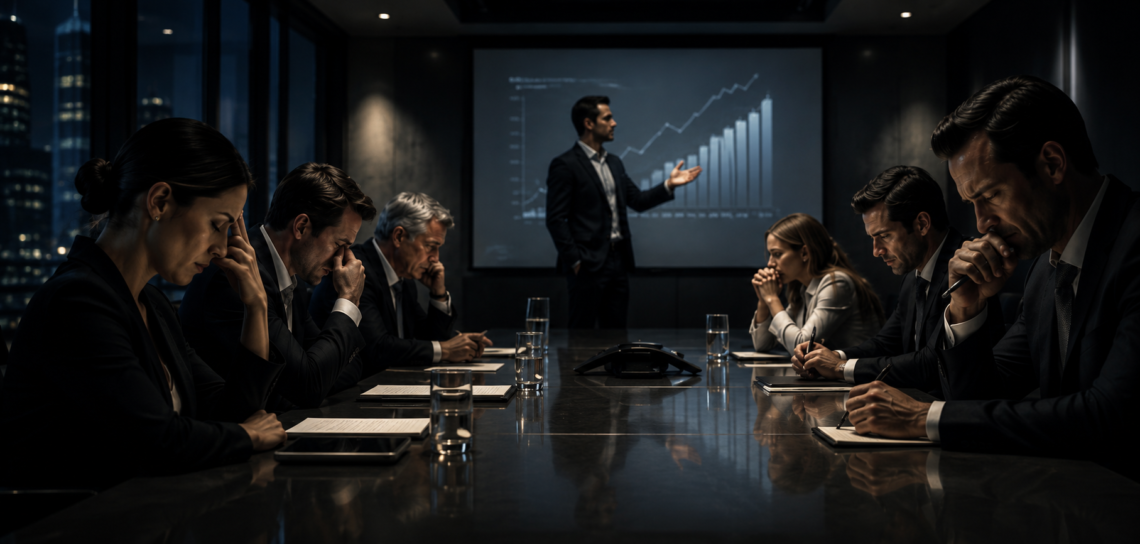
Notice something. You walk into a meeting room and feel the air shift before anyone says a word. What is that? Nobody told you anything. There’s no sign on the wall. But the body already knows. Shoulders creep up. Breathing gets shorter. And you haven’t even sat down yet.
I’ve worked with human behavior long enough to distrust any explanation that fits on a slide. And toxic culture is exactly that kind of explanation — something companies love to compress into bullet points, into “warning signs,” as if you could diagnose a sick organism by reading a checklist in an HR meeting.
You can’t.
Culture isn’t what a company says it is. Culture is what the body of everyone working there learns to do in order to survive. That changes everything.
Think about the driver who learns, without anyone teaching him, that at a certain intersection the light takes too long, so everyone just goes on yellow. He didn’t decide to break the law. He read the environment. He read the collective behavior and adjusted his own body to it. No internal debate, no prolonged moral reflection. Pure adaptation, the kind humans have been running on for far longer than any management manual has existed.
Toxic companies work on the same mechanism. Nobody trains anyone to be afraid. Fear settles in the same way the habit of running a yellow light does: through repetition, through watching, through silent social learning. Someone sees a colleague humiliated in a meeting and says nothing. Not because they agree. Because they just learned, in that exact second, that speaking up has a cost. And the body records that long before the mind puts together a coherent thought about justice, ethics, or courage.
That’s why so much of the conversation about organizational culture misses the target. It stays stuck at the level of speeches — values framed on a wall, an annual compliance training, a code of conduct nobody reads — while the real territory where culture gets decided is somewhere else entirely, more primitive, more physical: it’s what happens in the first three seconds after someone makes a mistake in a meeting. That’s where you see whether the environment punishes or learns.
Three seconds.
I wish companies took that as seriously as they take profit margin. Because those three seconds, multiplied by a thousand meetings, by a thousand small silent humiliations, by a thousand times someone lowered their head instead of speaking up, add up to something no climate survey ever captures right: the collective nervous system of an organization.
Yes. Organizations have a nervous system. Not literally, obviously, but functionally. There’s a shared emotional tone that runs through departments, that shifts from floor to floor, that puts an entire team on alert the moment a leader is in a bad mood, without a single word being said. Have you ever walked into a room and felt the tension without knowing why? That’s not oversensitivity. That’s the body reading signals it has always known how to read, long before any HR report existed.
And here’s the part almost nobody talks about: toxic environments don’t make people sick from overwork. They make people sick from overmonitoring.
There’s a huge difference between being tired because you worked hard and being drained because you spent the whole day monitoring your own behavior so you wouldn’t become the next target. The first kind of tired gets fixed by rest. The second kind eats away in a way vacation never touches, because the person isn’t exhausted by the work itself — they’re exhausted from spending eight, ten, twelve hours managing invisible social risk. Calculating what they can say. Calculating who’s in a good mood today. Calculating whether that comment will get used against them at the next review.
There’s a technical name for this, and I’m going to skip it on purpose, because naming it drains the life out of it. In my own work I just call it social vigilance fatigue. And it’s the real engine behind the productivity drop so many consultants try to explain with an engagement chart.
A person in a constant state of vigilance doesn’t think creatively. Can’t. When the brain reads threat in the environment, it redirects resources toward survival, not innovation. That’s not romantic language, it’s plain biological economics: the organism doesn’t spend energy creating while it’s spending energy defending itself. That’s why toxic companies, even the ones that demand innovation in every leadership speech, end up producing teams that are more and more operational, more and more obedient, less and less able to think outside the script. They ask for creativity in an environment that physiologically blocks creativity from happening. It’s like asking someone to run a marathon while you’re squeezing their throat.
And it costs money. Not in some abstract, philosophical way you can wave off in a quarterly report. Concrete, measurable money, the kind any finance director should be able to see if they looked at the right numbers. A company that keeps losing good people doesn’t just lose the person. It loses the knowledge that walked out the door, the time spent training whoever replaces them, the trust of the team that watched one more exit and started wondering if they’re next. A company where nobody feels safe pointing out a mistake doesn’t just lose morale. It loses the early correction that would have prevented the bigger failure down the line, because whoever spotted the problem first chose silence over risking their own position. None of this shows up on a balance sheet as “the toxicity line.” It shows up disguised as high turnover, rework, blown deadlines, innovation that never leaves the whiteboard. And most boards keep treating those numbers as an operational problem, when really it’s the symptom of a collective body that’s been trying to warn someone for a long time.
And there’s another layer that almost never comes up in these conversations: the role of collective silence.
Have you noticed toxic environments rarely have just one villain? There’s almost always a leader who abuses, sure, but what sustains that abuse isn’t him. It’s the audience. It’s the whole team watching, knowing, feeling the discomfort, and choosing, over and over, to say nothing.
That’s not cowardice, even though it looks like it. It’s a much older, much more universal phenomenon: when several people witness something wrong at the same time, each one quietly assumes someone else will act. Nobody does. And the reason nobody does isn’t a lack of individual character — it’s the cruel math of diffused responsibility. The more people who witness something, the less any single one of them feels responsible for stepping in.
Toxic companies are perfect factories for this. Packed rooms, crowded meetings, dozens of people watching the same abuse play out week after week — and nobody speaks, because everyone assumes the others’ silence means approval, and their own silence, without anyone meaning it to, becomes part of the problem.
And here’s something uncomfortable I need to say. Most people who stay silent inside toxic cultures aren’t bad people. They’re human. And the human body, historically, learned that disagreeing with the group, inside rigid hierarchies, is expensive. It used to cost you your place in the tribe. Now it costs you your job. The logic is painfully similar.
That doesn’t excuse anyone. It just explains why “be brave, speak up” campaigns work so poorly when they’re not backed by actual safety. Asking for individual courage to fix a structural problem is asking things backward. It’s like telling someone to swim against a strong current without giving them a life vest.
Now, what bothers me most in this whole conversation — and this is why I wanted to write about it differently than I have before — is the idea that toxic culture gets fixed by HR policy. It doesn’t. Policy fixes symptoms. What holds a toxic culture together is belief, not rules.
And belief doesn’t change by decree.
There’s a company that rolls out a reporting hotline, trains its leaders, publishes a code of ethics, and stays exactly the same, because nobody touched the deep belief underneath all of it: the mostly unspoken idea that pressure and fear produce better results than trust and safety.
That belief is far more common than any executive would admit in an interview. It hides behind innocent-sounding phrases like “we’re just a demanding place,” “there’s no room for mediocrity here,” “the market forces us to push hard.” Phrases that sound professional, even admirable, but carry a dangerous logic underneath: that suffering is proof of commitment.
I’ve watched smart, well-meaning leaders genuinely believe they were being demanding when they were actually being cruel. And the strangest part is that many of these leaders suffered the same way once. They learned to lead the way they were led. They reproduce, without noticing, the exact pattern that once hurt them, because it was the only leadership model they ever saw up close. Nobody’s born a toxic manager. Most people learn it by copying, the same way they learn to drive, to cook, to argue inside a relationship.
And this is where it gets genuinely interesting, because it completely changes the question we should be asking. It’s not “how do you spot a toxic culture.” It’s “why do so many competent leaders keep recreating environments they themselves once hated living inside.”
The answer isn’t comfortable. It’s because, at a very deep level, these leaders learned to associate pain with legitimacy. If I suffered to get here, the suffering is the fair price. If they demanded too much of me and I took it, demanding too much is the right way. It becomes a kind of distorted honor, passed down generation after generation of managers, as if it were a required rite of passage instead of a structural failure that needs to stop somewhere.
And there’s a gear that keeps this running in an even sneakier way: how these companies choose who gets in. A toxic hiring process rarely asks “do you know how to work safely.” It asks, disguised, “can you handle pressure,” “are you good with tough feedback,” “are you flexible enough for high-demand environments.” Questions that sound professional but are really testing one single thing: how well someone can swallow mistreatment without complaining. Whoever passes that filter isn’t the most capable. They’re the most trained at taking it quietly. And so the company goes on, one hiring cycle after another, filtering for exactly the people who will keep the same pattern alive, because they already proved, in the interview, that they know how to swallow.
When does someone decide the chain stops with him?
Real culture change requires breaking that transmission. And it doesn’t happen through a motivational talk or a one-day workshop. It happens when leadership agrees to ask the most uncomfortable question of all: what am I repeating here that once hurt me, and that I swore I’d never do to anyone?
Few companies have the courage to actually ask that, because it doesn’t fit in a quarterly report. It takes time, it takes vulnerability from whoever’s leading, it takes admitting fault in public, something most corporate structures still treat as weakness instead of strength.
In practice, this isn’t abstract. There’s the leader who makes a mistake in a meeting and, in front of everyone, stops and says “what I just did wasn’t right, let me redo this.” And there’s the other one who walks out as if nothing happened, leaving the room carrying a weight he’ll never name. The difference between the two isn’t in the values statement either of them signed at the start of the year. It’s in that exact second. That’s where culture actually gets decided — far more than in any annual leadership training. Because public correction, made right there, in the moment, teaches the whole team something no manual teaches: that making a mistake isn’t something to hide in shame, it’s part of the process, and it will be treated that way, openly, without ceremony and without disproportionate punishment.
But I believe, with a conviction I’ve carried since I started looking closely inside organizations, that healthy companies aren’t the ones that never make mistakes. They’re the ones that shorten the distance between the mistake and the fix. They’re the ones that understand psychological safety isn’t a nice-to-have from a feel-good company — it’s a biological requirement for any team to think clearly.
There’s something I’ve noticed for years that almost nobody names: toxic culture doesn’t just destroy the people who suffer the abuse directly. It also destroys the people who watch, because witnessing repeated suffering, unable to stop it, leaves a mark almost as deep as living the abuse itself. There’s a specific kind of exhaustion that comes from watching a coworker get humiliated week after week and being unable to do anything about it. The person wasn’t hit directly, but they carry the weight of having watched. And they carry the guilt of not having acted too, a guilt most people never put into words, because it sounds ridiculous to say “I’m suffering because of what happened to someone else.” It’s not ridiculous. It’s real, quiet wear and tear, slowly eroding the person’s trust in themselves, because deep down they know: if it’s their turn one day, nobody will act either.
That explains a mystery that puzzles a lot of managers: why employees who were never directly mistreated quit anyway, sometimes even first. It’s because the body doesn’t distinguish that well between suffering something and repeatedly witnessing someone else suffer it. For the nervous system, watching frequent humiliation activates nearly the same threat circuits as suffering the humiliation firsthand. I call this, in my own work, invisible emotional contagion — and it’s one of the most underestimated factors behind turnover in toxic companies.
And it’s worth opening your eyes to the fact that toxicity doesn’t always show up the same way. There’s the kind that shouts, that humiliates in front of everyone — that one’s easy to spot, because it leaves a visible mark, the body goes into full alert, and sleep disappears. But there’s the kind that whispers, disguised as a joke, as light irony, as an exclusion nobody can prove but everyone feels — that one wears you down slowly, corrodes from underneath, and it’s harder to name because nobody can point to the exact moment it happened. There’s the kind that shows up as an impossible target, a deadline nobody could meet, demands that normalize burnout as if it were just part of the job — that one doesn’t shout, it just pushes until the body breaks. And there’s the quietest one of all, made not of excess but of absence: the feedback that never comes, the recognition that never arrives, the feeling of being invisible even while giving everything you have to give. Four different shapes, four different ways of getting sick, and none of them need a raised voice to work.
And here’s a question I like to ask during consulting work, because it always disarms something in the room: how many good people have you lost, not because they did something wrong, but because they watched someone do something wrong to someone else and quietly decided they didn’t want to be part of that anymore?
That changes completely where the real transformation work needs to happen. Training only the abusers isn’t enough. You have to rebuild trust with the people who watched, because they’re carrying, inside them, an entire file of proof that the environment protects no one. And trust broken by repeated observation doesn’t get fixed with a nice speech at the quarterly meeting. It gets fixed by actually seeing someone held accountable when they mess up. Seeing real consequence. Seeing that next time, when someone abuses their position, there will be a response.
There’s also a dimension of human relationships inside these environments that I think is decisive and rarely discussed: the way corporate toxicity leaks into people’s homes. Someone who spends the whole day in a state of vigilance arrives home with no emotional energy left for their own relationships. They get short with a partner, impatient with a child, absent from a conversation that deserved presence. And that’s not a character flaw, it’s resource economics: whoever spent all day emotionally defending themselves at work comes home with an empty tank for the people they love. Toxic companies don’t stay contained inside their own building. They cross the front door, sit down at the dinner table, and nobody notices where that exhaustion, bigger than the day should account for, actually came from.
Culture doesn’t change through speeches. It changes when someone with decision-making power chooses to act differently the first time they had the perfect excuse to act the way they always have.
And maybe that’s exactly what separates a company that heals from a company that keeps quietly making sick the people who trusted it with their own time on earth.
If this resonated, it’s just a fragment of everything I keep investigating about human behavior inside organizations. Find hundreds of other pieces like this on my blog: marcellodesouza.com.br
#toxicworkculture #humanizedleadership #psychologicalsafety #emotionalcontagion #marcellodesouza #marcellodesouzaoficial #coachingevoce
Marcello de Souza | Coaching & Você
marcellodesouza.com.br
© All rights reserved
Se isso fez sentido para você, existe um próximo passo possível
Algumas reflexões não terminam no conteúdo — elas continuam em forma de diálogo, aprofundamento ou sustentação de um trabalho contínuo.

EL CUERPO AVISA

Você pode gostar

THE HAPPINESS THEY SOLD YOU WAS NEVER YOURS

YOU DIDN’T GET WHERE YOU ARE TO REMAIN WHO YOU’VE ALWAYS BEEN