THE SUITCASE THAT NEVER CLOSES
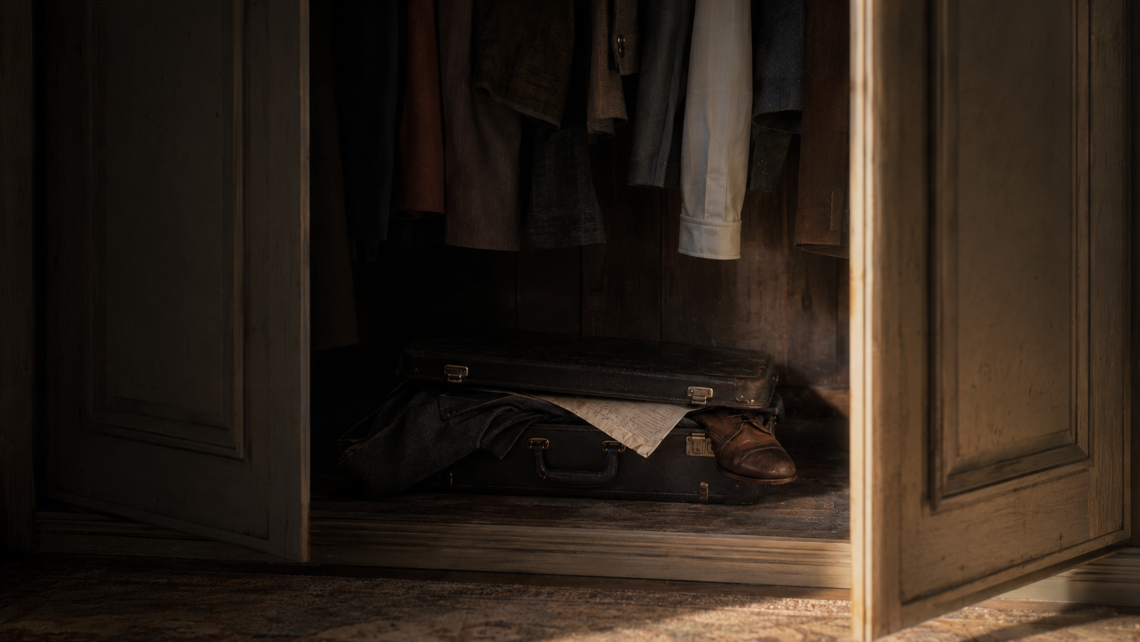
There’s a suitcase somewhere in your house that never goes fully empty and never gets fully packed. It holds half a season. A jacket that might be needed if the weather turns, a document that might matter if the trip happens, a pair of shoes that only exist for “just in case.” It sits there, half-zipped, in the back of the closet or on top of the wardrobe, occupying a space that belongs neither to leaving nor to staying. And the strange part is that nobody consciously decided to keep it that way. It just stayed.
I know people who live inside that suitcase. Not literally. Living in a marriage that has been almost-ending for eleven years. Living in a career that has been almost-changing since before the pandemic. Living in a city that is almost the final one, in a relationship with their own body that is almost healthy, in a project that is almost ready to show the world — one adjustment left, always one adjustment left, the same adjustment for seven years.
I’ve written before about the almost that disguises itself as ethics, the almost that becomes a moral excuse, the almost that quietly steals a promotion inside a meeting room. There’s an older almost than all of those, a founding one, that doesn’t live in a specific promise or a specific room. It lives in the entire architecture of a life. And this one I hadn’t named yet: the almost that replaces the decision with the indefinite maintenance of the possibility of deciding.
Notice this isn’t ordinary indecision. Ordinary indecision has a deadline — you can’t tell if you want the fish or the steak, the waiter comes back in five minutes and someone chooses for you, even if it’s just hunger doing the choosing. What I’m describing has no waiter. No deadline. It can last an entire life, because, without anyone meaning to, it was built to last exactly that long.
Think about your phone. Some people never let the battery hit a hundred, distrust their own charge, keep twenty percent as a kind of moral reserve, as if living that day fully were a bigger risk than living it halfway every single day. Nobody theorizes this. Nobody decides, on a random Sunday afternoon, “from now on I’ll use my life at eighty percent.” But that’s exactly what happens when the marriage, the project, the move to another city, the book, the child someone keeps thinking about having, all of it gets stuck in the same mental compartment as the battery that never fully charges.
And here a pause is worth taking, because the most comfortable explanation for this is wrong. The comfortable explanation says it’s fear. I disagree. Fear has a face, a trigger, a moment when it tightens the chest and then passes. What I’m describing doesn’t tighten the chest. It’s smooth. Manageable. It’s the person who can, with perfect calm, explain to you and to themselves why it still isn’t the right time — and the explanation, notice, is always reasonable. I’ve grown deeply suspicious of people who explain too well. Because the part that knows how to articulate the reason is rarely the same part actually holding the suitcase handle. One speaks with clarity; the other decides in silence, without asking the first one’s permission. And while the one that speaks keeps telling the pretty story, the one that decides keeps doing exactly what it’s always done — which changes nothing, because whoever was actually in charge from the start was never invited to the conversation. Money’s short. The kids aren’t old enough yet. There’s no clear enough sign. One thing needs to finish before another can start. Each reason, alone, convinces. Add them up, year after year, and you get a whole life lived in a waiting room.
A waiting room is a good image for this, because there’s something only people who’ve spent real time in one understand: nobody truly settles in there. The chairs are uncomfortable on purpose. Nobody takes off their coat. Nobody starts a thick book. Everyone is in a mode of temporary suspension, because at any moment someone will call their name and real life will resume on the other side of the door. The problem is when the door never gets called — or worse, when it’s called several times and the person pretends not to hear, because, deep down, the waiting room has become safer than the room inside.
I watched this happen every day, decades ago, back when I managed cell network rollout projects for a city that had no signal at all yet. The whole equipment sat stored, ready, tested, inside the truck, waiting for final authorization to be installed. Sometimes that authorization took days. And the strangest part wasn’t the delay — it was watching how the crew, after a while, stopped asking when it would move. They just stayed there, tending to the stopped material, as if tending the wait had become the job itself. That’s exactly what I see today, decades later, except the stopped material isn’t antennas or hardware anymore. It’s somebody’s life.
There’s something I notice often in people who come to me carrying this suitcase without knowing they carry it: almost always, at some point in their life, they were praised specifically for not deciding. The child who never threw a tantrum over which toy to pick earned a reputation for being easy. The teenager who accepted whatever college their parents suggested, no pushback, got called mature. The adult who never questions the direction the company gave their career is “easy to work with.” Each of these compliments seems harmless on its own. Together, across twenty, thirty years, they teach a silent equation: deciding on your own creates friction, and friction is dangerous, so the safest route is to let life decide for you and call it flexibility.
Nobody warns this person that the deal has an expiration date. It works fine through your twenties, maybe early thirties. Then the big life events stop arriving pre-scheduled, with a date printed on the outside — no more graduation pushing you toward the next step, no one left organizing the next chapter for you. And that’s exactly when the person finds out, often too late, that they never learned to do alone what had always been done for them: choosing, and living with it.
I also notice something curious when this comes up between friends at a bar, or in a session, doesn’t matter which: almost everyone can spot the other person’s half-open suitcase with surgical precision. “You’ve been talking about that relationship for five years like it just started.” “You complain about work every single week, but you never send out a résumé.” The person listens, agrees, even laughs a little at themselves — and, the following week, climbs back into their own suitcase like someone returning to an old house, uncomfortable but familiar. Because seeing the pattern intellectually and dismantling it emotionally are two entirely different operations, and the second doesn’t happen just because the first did.
And here I need to open a parenthesis I consider too dangerous to leave out. I’ve watched brilliant people, capable of naming their own escape mechanism with surgical precision, keep running from it the exact same way, year after year, as if understanding the maze were enough to walk out of it. It isn’t. Worse: sometimes understanding becomes the new suitcase. I call it self-knowledge with a revolving door. The person walks in, names everything with impressive clarity, walks out the same door, and goes back to doing exactly what they were doing before — just now with vocabulary. “I know I avoid commitment because of my childhood.” “I know I sabotage good relationships because I learned to distrust stability.” The sentence is true, almost always true, and that’s precisely why it works so well as an excuse. Self-knowledge, in these moments, becomes a luxury alibi. Instead of a tool for change, it becomes a certificate of absolution. “That’s just how I am” stops being a confession and becomes a final verdict, shielded from any accountability — including the accountability the person would otherwise demand of themselves, if they didn’t have all that vocabulary on hand. I know people who use their own ego, dressed up as awareness, to never have to move: “I’ve already figured out my pattern” has become, for them, a synonym for “so I don’t need to work on it anymore.” Understanding isn’t the end of the road. It’s just the sign that shows you where you’re stuck.
I think about this a lot as the difference between the map and the territory. The map is understanding — the ready-made phrase, the pretty explanation, the “I know why I am the way I am.” The territory is the raw experience of deciding and living with what comes after, good or bad. And life doesn’t happen on the map. Life happens in the territory. Nobody pulls experience out of thin air; you have to step on something real, feel the wrong weight on your shoulders, take a wrong turn once, to gather a new thread of experience that didn’t exist before. Whoever only handles maps keeps sewing with the same old threads, because they never harvested a new one — they can render the territory in ever finer detail, ever sharper precision, and still have never set foot on it. That’s why understanding your own pattern doesn’t move anything by itself. Understanding is the map. And a map, no matter how well drawn, never walks for anyone.
There’s a nice clinical name for this phenomenon, but I’d rather not use it, because naming something with technical precision tends to give the false sense that the problem’s already been understood. I’d rather describe what happens underneath: the person isn’t avoiding the decision. They’re avoiding the grief that comes after it. Because every real choice shuts down the other possibilities that weren’t chosen — and that’s the small funeral, silent, invisible, that nobody wants to walk through. Choosing to stay shuts down the version of you that would have left. Choosing to go shuts down the version of you that would have stayed. There’s no decision without that goodbye. And the half-open suitcase is, at bottom, a desperate attempt to never have to say goodbye to anything.
Except there’s a myth built into this story that I also need to take apart here, and it doesn’t get dismantled by denying the loss. It gets dismantled by holding both truths at once. They say every choice is loss, and that’s true: choosing to stay really does shut down the version of you that would have left, and that closing hurts, it needs to hurt, because it’s real grief. But they also say, with the same conviction, that choosing is only loss, and that’s where they stop telling the whole story. Because in the very same instant you lose the possibility you didn’t choose, you gain the one that made sense — and it’s that gain, not the absence of loss, that holds the choice together afterward. Maturity isn’t learning to lose nothing. It’s learning to look at what was lost and still say: it was worth it, because what I gained weighs more. Whoever dodges that full accounting — pretending they only lost, or pretending they only gained — never makes peace with their own choice. And it’s precisely to avoid that whole accounting, gain and loss together, that so many people prefer to close nothing at all: as long as nothing is chosen, there’s no loss to mourn and no gain to carry. There’s only suspension, which sends no bill to anyone — until, decades later, it charges the steepest price of all.
Still, the body doesn’t accept that deal for long.
It collects. Collects in bad sleep, in irritation with no obvious cause aimed at the people who least deserve it, in exhaustion that no amount of rest fixes because it isn’t a body’s exhaustion, it’s the exhaustion of standing in two places at once for years. It collects on birthdays that hurt more than they should. It collects in a strange, almost physical sense of always running a step behind your own age — as if part of you got left standing on a platform while the train kept moving without that part on board. And none of it is an accident, even though we’d rather call it stress, a rough patch, too much work. Forgetting mid-sentence, the wrong word slipping out at the wrong time, the body getting sick in the exact week the decision needed to be made — that’s speech. Not by chance, but with its own stubborn logic, insisting on puncturing the official version of the story every time the official version starts lying too much.
And what if the truth is this: you’re not waiting for the right time. You’re waiting to not have to choose at all.
There’s an enormous difference between the two, and that’s exactly where the most sophisticated trap in this whole mechanism lives. Waiting for the right time is wisdom. Waiting to avoid choosing is the most expensive fantasy an intelligent person can afford, because it borrows the vocabulary of wisdom to disguise paralysis. “It’s just not the right moment” sounds mature. “I’d rather not rush into it” sounds responsible. But repeated year after year, about the same thing, that sentence stops being prudence and becomes personal anthropology — becomes the only way that person has ever known how to relate to their own wants.
I dare you to try something simple and uncomfortable: grab a piece of paper, or open a note on your phone, and write down the three sentences you repeat most often to postpone something important. Not the big philosophical decisions of life — the concrete ones. The course you were going to take. The conversation you were going to have with that specific person. The doctor’s appointment, the test, the resignation letter, the marriage proposal, the move across town, the divorce that’s already been decided internally for years and just hasn’t been signed on paper yet. Write down the exact sentences you use. And pay attention to something: “I’ll see,” “one of these days,” “I just need to get organized first” aren’t only descriptions of an indecision sitting behind them. They are the indecision at work, functioning, doing the job of keeping everything exactly where it is. The person thinks they’re describing a state. What they’re actually doing is producing that state, every time they open their mouth. Then ask yourself: how long has that sentence been in your vocabulary? A year? Five? Ten?
If the answer scares you, it should.
I’m not writing this to blame anyone — blame is just another way of staying stuck, except stuck and feeling bad about it, which changes exactly nothing in practice. I’m writing this because there’s a subtle, decisive difference between waiting and postponing, and most of us never learned to feel that difference in the body. Waiting is rooted in something real outside you — a missing document, an objective condition, an event that hasn’t happened yet. Postponing is rooted only inside you, and the most common disguise for postponing is pretending the root is out there somewhere.
There’s another side to this story almost nobody tells, because it isn’t a pretty thing to admit: sometimes the half-open suitcase brings a certain kind of pleasure. It protects against the most concrete sadness there is, the failure of a choice actually made. As long as you don’t decide for good, you can still be, in your imagination, anything at all. The successful entrepreneur you would have been if you’d started that business. The happy couple you two would be if you’d really invested in each other. The writer that exists, intact, in the version of the book that’s never been finished. The day you finish the book, it might be bad. The day you open the business, it might fail. The day you actually invest in the relationship, it might stay exactly as it is — and then there isn’t even the hope left that maybe, someday, it would have worked. The half-open suitcase protects you from the real failure by trading it for a permanent, invisible one, which hurts less because it’s never named.
Except an invisible failure is still a failure. Just without a date. Without an eve. Without the right to the grief any real failure deserves.
And here’s maybe the deepest layer of it, one that took me years to name without sounding cynical. The person doesn’t just fear the failure of the choice. They fear losing the lack that keeps them moving. Because it’s the lack — the “not yet,” the “someday” — that gives meaning to a good part of what they do all day. It’s the lack that justifies the effort, that props up the fantasy, that lends a reason to get out of bed even when the real reason lives somewhere else. Desire that gets satisfied, strange as it sounds, empties itself out. Closing the suitcase isn’t only the risk of getting the choice wrong. It’s the risk of killing the very lack that, until then, held everything together. That’s why so many people would rather keep the lack alive than risk killing it for good — even knowing, somewhere underneath, that an eternal lack is also a form of death, just a slower one, a politer one, with no burial at all.
There’s a way to tell whether you’re in a legitimate wait or a flight disguised as one, and there’s nothing mystical about the test. Ask yourself: if the missing condition showed up tomorrow morning, would you act? If the answer is yes, with your whole body, you’re genuinely waiting. If the answer comes hesitant, if it comes wrapped in “but then I’d need to think it over more” or “but then something else would come up,” you already know. The condition was never the obstacle. It was just the pretty name you gave the real obstacle, which is deciding and then living with the weight — good or bad — of having decided.
Notice this test bothers people precisely because it leaves no exit through logic. It’s useless to argue rationally that the condition is legitimate, because the question isn’t about the condition — it’s about the body, about what it does when it imagines the condition already resolved. If the body relaxes and moves, it was waiting. If the body tightens and already reaches for the next excuse, it was flight wearing the costume of waiting. And the most uncomfortable part is that most of us already know, deep down, which of the two answers is true. We just avoid asking the question out loud.
There’s also a cruel arithmetic in all of this, one nobody does because doing it hurts. If a person lives, on average, into their eighties, and spends ten, fifteen of those years inside this half-open suitcase — not quite living, not quite leaving, just managing the possibility — they haven’t only lost calendar time. They lost the version of themselves that would have existed if they’d decided at thirty what they only decided at forty-five. That version doesn’t come back. It isn’t that it stayed behind, waiting, like some character in a film. It simply never got to exist, and grief for something that never existed is the hardest kind of all, because there’s no image to cry over, no photograph, not even a name.
And here, maybe, lies the deepest mistake of anyone who thinks they’re escaping grief by not choosing. They’re not escaping it. They’re trading one grief for another without noticing the trade. The grief that follows a choice has a date, a ritual, an object — it hurts once, hurts deeply, and then starts to scar over, because a scar needs a closed wound to exist. The half-open suitcase trades that grief for a different one, with no date, no ritual, never closing into a wound — a diffuse grief, spread out over years, never quite painful enough to force a turning point, never quite faint enough to leave the person in peace. It isn’t the absence of grief. It’s chronic grief for the life that never started, billed in installments too small to notice, too large to ignore.
And still — and maybe this is the most generous part of the whole story — the suitcase can close at any age. There’s no expiration date on giving up the management of the wait and starting to live what’s been waited for. The body that’s carried the suitcase for twenty years is the same body capable of setting it down tomorrow morning. The difference between the two isn’t time, and it isn’t courage in the dramatic sense of the word. It’s just the instant, always available, always right there, when someone stops asking if it’s the right time and starts acting as if it already is.
I once knew, a long time ago, a man who repaired suitcases in a small town. He made his living restoring what everyone else had already given up on using — a jammed zipper, a torn strap, a buckle that no longer closed. One day I asked him why he never sold new suitcases, since he clearly had the skill for it. He said nobody learns to close a new suitcase properly. You have to carry something inside it first, feel the weight sit wrong, adjust, try again, until the body finally understands exactly what fits and what doesn’t. Suitcases that close easily, he said, are almost always empty on the inside. The ones worth repairing are the ones that have already traveled, already gotten the fit wrong, and someone still insists on making them close again. I don’t know if he knew what he was actually telling me. I walked out of there thinking about mine.
📌 If this piece touched something in you, there are hundreds of other reflections on my blog about human behavior, decisions, relationships, and the quiet mechanisms that hold up — or paralyze — an entire life. Visit marcellodesouza.com.br and let’s keep this conversation going.
#TheSuitcaseThatNeverCloses #PostponedDecisions #LifeInSuspension #HumanBehavior #RealSelfKnowledge #marcellodesouza #marcellodesouzaoficial #coachingevoce
Marcello de Souza | Coaching & Você marcellodesouza.com.br © All rights reserved
Se isso fez sentido para você, existe um próximo passo possível
Algumas reflexões não terminam no conteúdo — elas continuam em forma de diálogo, aprofundamento ou sustentação de um trabalho contínuo.

LA RIGIDEZ QUE LLAMAS CARÁCTER

LA MALETA QUE NUNCA CIERRA
Você pode gostar

EFEITO CONTAGIOSO DO COMPORTAMENTO NO TRABALHO – PARTE 1
A VIOLÊNCIA INVISÍVEL DA COMUNICAÇÃO CORPORATIVA
