WHAT THE BRIDGE CANNOT REPAY
On the invisible cost of everything we build — and what to do with the stones no one sees
BEFORE ANYTHING ELSE, A FABLE
Read it slowly. Everything that follows grows out of it.
Teodora’s Apron
The bridge over the Arraial would take eleven years, said the engineer from the capital, and he left on the same train that had brought him. Teodora stayed — she could read a blueprint and shout at men, the two things the job of forewoman required.
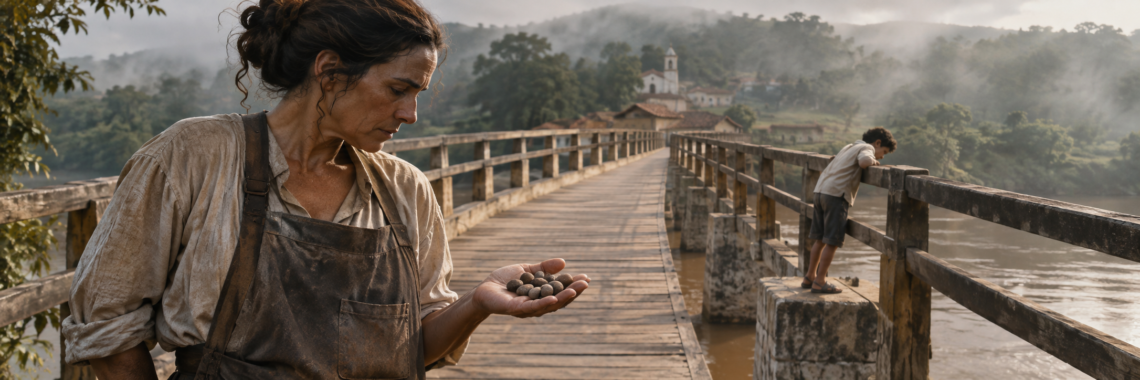
In the third winter, Bento slipped from the scaffolding of the second pillar. Teodora went down to the riverbank, crouched beside him for a while and, before climbing back up, picked from the riverbed a stone the size of a thumb, which she slipped into her apron pocket without a word to anyone.
After Bento came Licínio, the Arruda twins, a young man whose surname nobody knew. Each one became a stone. The apron began to sag to the left, and she learned to walk compensating, her right shoulder a little higher, so that anyone who saw her from afar crossing the worksite in the morning mist imagined a woman forever carrying an invisible bucket.
In July of the seventh year, the twins’ mother came three leagues on foot.
— Are you going to finish it?
— I am.
— What for?
Teodora looked at the pillar, then at the woman. She had an answer about the market on the other side, about the doctor who might come, about the children who would no longer have to wait for the dry season to cross. She found the answer indecent before that mouth.
— I don’t know — she said.
The woman spat on the ground, near her foot, and Teodora stayed where she was.
That night she counted the stones on the table of the boarding house. Nine. She did the math she had never done: how many people would cross each year, how many years a bridge lasts. The number grew enormous and was of no use at all. She put the stones back, one by one, in order.
The bridge was finished four months late. There was a band, a congressman, a green ribbon. The congressman spoke of progress and nobody listened, because a little boy had slipped away from his mother and was running across the deck, his sandals slapping the new wood, all the way to the middle, where he leaned over the railing and spat into the river to see how far down it was.
Teodora waited for everyone to cross. Alone at the head of the bridge, she reached into her apron and took out the stones. She weighed them in her palm. Below, the river ran brown, carrying off whatever fell into it.
She closed her hand. Then she opened her pocket, put the stones back and began to cross, her right shoulder a little higher.
“If human life has no price, we always act as though something surpassed human life in value… But what?” — Rivière, in Night Flight, by Antoine de Saint-Exupéry
*
How many stones are in your pocket right now? Not real ones. The other kind, the ones you picked up without explaining to anyone. The meeting where you signed off on letting go of someone who had just taken out a mortgage. Your child’s birthday, watched on a phone screen in an airport lounge, badge still hanging around your neck. The conversation with your father that you postponed until after the quarter closed — and the quarter closed, and so did your father. The partner who was left behind when the company had to change course. The marriage that, without anyone quite noticing when, turned into logistics. Each of these has weight, has size and, if you are honest, has a numbered place in a line that only you can see.
The woman on that bridge has not let go of me for weeks. Teodora, her apron sagging to one side, one shoulder slightly higher, crossing the worksite in the morning mist like someone carrying a bucket nobody can see. I know this woman. You probably do too. You might be her.
*
We live in an age that loves to justify. Every loss has to fit inside a story of gain: mass layoffs become “a restructuring essential to the long-term health of the business,” absence at home becomes “an investment in the family’s future,” the body that breaks down becomes “the price of getting there.” There is an entire industry devoted to turning what hurt into a lesson, what was lost into growth, what died into fertilizer. I distrust it. Deeply.
Not because the justifications are false. What troubles me is the opposite: so many of them are true. The restructuring may well have saved five hundred jobs at the cost of fifty. The hours away may well have paid for the school, the health plan, the holiday. The bridge, after all, will bring the doctor across the river, shorten the road to the market, spare the children from waiting for the dry season to cross. All of it true. And, in front of certain mouths, all of it obscene.
The twins’ mother walks three leagues to ask a single question. Are you going to finish it? I am. What for? Teodora has the answer ready — the market, the doctor, the children — and realizes, at the very instant she opens her mouth, that this answer, however correct, would be an indecency. So she says the only thing that fits: I don’t know.
How many times, in a meeting room, at a dinner table, in a hospital corridor, have you had the right answer and felt it was indecent? And how many times did you say it anyway?
*
There is a distinction almost no one makes, and to me it is what separates those who lead people from those who merely manage processes: the difference between having reasons and having the right to use them. The manager who announces cuts with flawless charts has reasons. The father explaining why he missed the school play has reasons. The mother who tells her teenage daughter she works so hard “for her” has reasons. Everyone does. The thing is, a reason offered to someone who has lost something rarely works as an explanation. It works as a closing — a door being eased shut, gently, saying between the lines: it has been accounted for, we can move on, you no longer need to feel this. And the person feels it more, because now, on top of the loss, they carry the loneliness of having been invited to stop feeling.
The mother spitting near Teodora’s foot may be the most lucid reply anyone can give to a justification that was never even spoken. She does not spit in her face. She spits close by. She marks the ground, a gesture that says: I saw you choose not to explain, and that was the least you could do, and it is still not enough.
And Teodora stays where she is.
I suspect this is the hardest and rarest gesture of adult life. Not hitting back, not defending yourself, not rushing to the next appointment, not sending HR to have the conversation, not changing the subject at dinner. Staying. Leaving the spit on the ground, near your foot, without wiping it away. I have watched brilliant executives unable to hold thirty seconds of silence in front of someone who lost something because of a decision they made. I have watched parents who prefer a fight to silence, because a fight at least has a script. The silence of someone who suffers because of us has no script at all; it demands presence without armor. And presence without armor is something few of us ever learned, because almost everything we were taught about being competent was, underneath, a school of defenses.
*
That night, Teodora spreads the stones on the table of the boarding house. Nine. And for the first time she does the math she had never done: how many people will cross each year, how many years a bridge lasts. The number grows enormous and is of no use at all.
I read that line and think of every spreadsheet I have seen trying to prove it was worth it. Return on investment, growth rate, number of lives impacted, the family that now owns a house, a car in the driveway, college paid for. Enormous numbers, honest, audited — and, before a single stone on a table, useless. Some things simply do not belong to the same arithmetic. A life is not a fraction of a million crossings. A child who grew up without you on the nights of fever is not compensated by a trip to Disney. The trust of a team that watched colleagues leave without a goodbye is not rebuilt by next year’s bonus. It is not that one side is worth more than the other; they are in currencies that do not convert.
The corporate world, and more and more the domestic one, runs on the fantasy that everything converts. Time into money, money into comfort, comfort into affection, affection back into time — one vast currency exchange where every loss can be traded for an equivalent gain, as long as you find the right rate. Teodora knows, at that boarding-house table, that there is no rate. And she does something that moves me more than any conclusion could: she puts the stones back, one by one, in order.
In order. She does not dump them into her pocket all at once, does not turn them into a heap. Each of the dead remains someone, with a place of his own, a before and an after. Bento was the first, then Licínio, then the twins, then the young man whose surname nobody knew. Order is a form of respect. It is refusing to let the sum erase the name.
How many organizations do you know that keep their losses in order? That remember who left, when, why, and what it cost those who stayed? How many families? Most of us prefer the heap. The heap is lighter, because it is anonymous. “We had a tough year.” “We’ve had our ups and downs.” Heap-sentences — in other words, sentences that dump every stone into a single pile so that none of them has a name. Sentences that gather everything up so you never have to hold anything in particular.
*
I want to challenge something that may be crossing your mind right now. Perhaps you think I am defending guilt, that the message is to carry the weight, to suffer over every choice, to walk crooked forever. It is something stranger, and more demanding, than that.
Guilt is a weight that asks for absolution. It wants to be forgiven, relieved, wants someone to say “it wasn’t your fault” so it can finally be put down. Guilt is restless, it makes noise and, often, it is just another form of vanity — the suffering of someone who needs the world to see how much they suffer. Teodora’s stones ask for nothing. She shows them to no one, uses them neither to redeem nor to punish herself. She simply carries them, and her body changes to make room: the shoulder rises, the stride adjusts, and anyone watching from afar senses something different without knowing exactly what.
There is an enormous difference between carrying what it cost and drowning in what it cost. The first is fidelity; the second, surrender dressed up as remorse. And there is a third way, the most traveled of all: active forgetting — the one that throws the stones into the river.
*
The bridge is finished four months late. A band, a congressman, a green ribbon. The congressman talks about progress and nobody listens, because a little boy has slipped away from his mother and is running across the deck, sandals slapping the new wood, all the way to the middle, where he leans over the railing and spits into the river to see how far down it is.
Notice that the story has two acts of spitting. The mother’s, heavy with grief and contempt, marking the ground near the one who wounded her. And the boy’s — light, curious, playful — measuring the height of something he has no idea what it cost. The same gesture, two worlds.
It is in the second that the bridge finally makes sense. Not in the speech about progress, which nobody hears, nor in the count of yearly crossings, which was of no use. Meaning shows up in a boy who knows nothing, owes nothing, carries no stone at all, and uses the bridge to play at measuring the world.
That strikes me as an almost unbearable truth. Everything we build that truly matters will one day be used by people who will never know what it cost, and it is right that it should be so. Your child will grow up and cross the bridge you raised without knowing about the nights, the fears, the things you gave up, the stones; they will spit from the railing to see how far down it is. The team you shaped will reach places without remembering who fell from the scaffolding along the way. The company that survived the crisis will be full of new people who assume it was always like this. And your wish — human, understandable — will be to ask them to know, to acknowledge, to be grateful, to look back and see the stones.
The boy’s lightness is precisely what the bridge existed to make possible. Had he crossed carrying the grief of those who built it, the bridge would have failed: it would have passed on the weight when it was meant to pass on the crossing. Perhaps this is one of the quietest forms of love there is — building something that lets the other be light, without demanding that they know how heavy it was.
*
I think of families where parents spend a lifetime collecting acknowledgment for their sacrifices. “I gave up my life for you.” “Everything I did was so you could have what I never had.” True, almost always — and sentences that turn the bridge into a debt. The child crosses, only now with the father’s stone in their pocket, guilty for crossing at all.
I also think of the opposite: families that throw everything into the river. No one mentions the brother who drifted away, the bankruptcy that changed everyone’s life, the grandfather who drank, the separation never explained to the children. The river runs brown, carrying off whatever falls into it, and the family carries on as if the bridge had always been there. Except that what falls into the river does not disappear. It drifts downstream. It ends up somewhere further on, sometimes a generation later, stranded on the bank of someone who has no idea where it came from.
In organizations the pattern repeats. Some companies turn every loss into a founding myth and start demanding from newcomers a loyalty proportional to the suffering of the old guard — “we’ve been through a lot here.” Others erase everything, swap the logo, rename the department, rewrite the history on the corporate website, and are surprised when, years later, the culture repeats exactly the mistake that caused the first disaster. Between debt and oblivion there is a third thing, the hardest one: the woman at the head of the bridge.
*
She waits for everyone to cross. She does not cut the ribbon, does not go first, does not place herself at the center of the ceremony. She waits for the bridge to belong to others before it belongs to her. There is an ethic in this that almost no leader practices, and almost no parent either: letting the work belong first to those who will use it.
Alone at the head of the bridge, she reaches into her apron and takes out the stones. Weighs them in her palm. Below, the river runs. This is the moment of temptation. Eleven years of a crooked shoulder, the work done, no one watching. All she has to do is open her hand: the river would take everything, and she could cross standing straight for the first time in a decade. Who would judge her? The bridge stands, the debt, if there ever was one, is paid, the boy has already spat from the railing.
This is exactly where she closes her hand. Then she opens her pocket, puts the stones back and begins to cross, her right shoulder a little higher.
I have read that scene many times, and each time it tells me something different. Today it tells me that finished work frees no one from what it cost — nor should it. Whoever crosses straight-backed over a bridge that killed nine men has learned nothing about bridges. Whoever crosses carrying the stones, without showing them, without charging for them, without throwing them away, crosses together with the dead. Carries them to the other side. It may be the only possible way for them to arrive as well.
*
I return to the question that haunts anyone who has ever had to decide something big. If human life has no price, why do we always act as though something were worth more than it? I have heard many answers — the work, the future, the cause, progress, family, the company. They all sound good, and all of them, one way or another, slide back into the spreadsheet and become justification.
I see it differently. I do not know whether anything is worth more than life; I suspect nothing is. The question may simply be badly framed. What keeps us moving forward, even after every stone, may not be something worth more, but something that refuses to be traded. A fidelity that bargains neither with grief nor with success. The refusal to abandon the work — and the equally firm refusal to let the work erase those who fell into it. Going on without sufficient reason. Finishing without being able to explain what for. Saying “I don’t know” to the mother who walked three leagues and, the next day, going back to raising the pillar. This is not coldness; it sits closer to the opposite. It is knowing that no answer would be equal to the moment, and therefore offering none, and therefore going on.
The people of greatest integrity I have met, in almost three decades of accompanying people and organizations from the inside, were not the ones with the best justifications. They were the ones who walked slightly crooked. The ones who remembered, without fuss, the names of those who had left. The ones who did not use results to anesthetize the cost. The ones who, at home, did not demand their children’s gratitude for what they had lost — and still did not pretend they had lost nothing. People you recognize from a distance, crossing the worksite in the morning mist, and think: that person is carrying something.
*
And you? What bridge are you raising right now, in this season of your life — a career, a business, a marriage, raising a child, helping someone you love recover? How many stones are already in your apron? Do you know their order? Do you know their names? Or have you already thrown a few into the river, on some ordinary afternoon, so you could walk a little straighter?
When someone you hurt, out of necessity or by choice, came to ask “what for?”, what did you say? The market, the doctor, the children? The numbers, the target, the future? Or did you have the courage to say “I don’t know” and stay where you were, with the mark on the ground near your foot?
And when the work is finished, if it ever is, will you demand that the boy know what it cost? Or will you let him spit from the railing, light, measuring the distance, while you wait for everyone to cross?
Down below, the river keeps running brown. And someone, at the head of the bridge, closes a hand.
If this piece is still echoing in you, hundreds of other reflections on human behavior, leadership and relationships that grow — at work and at home — are waiting for you on the blog. Visit marcellodesouza.com.br and keep this conversation going.
#invisiblecost #leadership #humanleadership #familyrelationships #organizationalculture #grief #accountability #humandevelopment #humanbehavior #peoplemanagement #marcellodesouza #marcellodesouzaoficial #coachingevoce
Marcello de Souza | Coaching & Você
marcellodesouza.com.br
© All rights reserved
Se isso fez sentido para você, existe um próximo passo possível
Algumas reflexões não terminam no conteúdo — elas continuam em forma de diálogo, aprofundamento ou sustentação de um trabalho contínuo.


LO QUE EL PUENTE NO PAGA
Você pode gostar

YOU ARE WHAT YOU DO, NOT WHAT YOU SAY YOU WILL DO! PART 2

Reflections on new paths of renewal