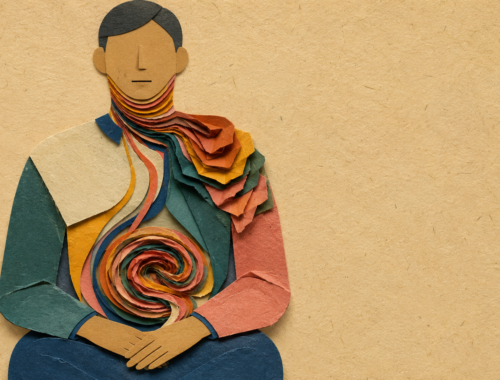
WHAT NEVER COMES BACK
On rebuilding after the sacred has been breached — and why repair is never the same as return
There is a day after. Nobody talks about it, because the culture of instant reconciliation prefers to jump straight from the apology to the embrace, as if between the two there weren’t an immense, silent territory where the wounded person is still calculating whether what’s left of them is enough to keep going.
Have you ever been in that day after? The one where the person who crossed what was yours — your word, your body, your trust, your most closely guarded secret — has already said they’re sorry, has maybe already cried, has perhaps even rationally understood the size of what they did. And still, something in you remains locked. Not out of resentment. Out of physics.
Popular therapeutic culture sold a dangerous promise: that every rupture has a fix, as long as both sides bring goodwill. It’s a lie, and it’s a lie that produces a specific kind of suffering — that of the person who did everything right after the mistake and still didn’t find the other person the same way as before. Because the question was never whether it can be fixed. The question is whether it’s possible to go back. And here lies the first uncomfortable truth: it isn’t.
Kierkegaard wrote, in a small and almost forgotten book, about the difference between recollection and repetition. To remember, for him, is to look backward, to relive what already was. To repeat is something else — it is to live forward while still being, somehow, the same person. Kierkegaard argued that true repetition does not exist in the naive sense of recovering what was lost, intact. What repeats is never identical to what was. It is another version, carrying the mark of the interval. Whoever expects a relationship, after being violated, to return to its previous shape is asking for recollection. But a relationship doesn’t remember. A relationship repeats — forward, different, or it doesn’t repeat at all.
This changes everything. Because most of the pain of the “day after” doesn’t come from the violation itself. It comes from the demand, explicit or silent, that the wounded person pretend they can go back to a place that no longer exists. “I already apologized, what more do you want” is the sentence of someone asking for recollection. And recollection cannot be delivered on demand.
Think of a cup that cracks. You can glue it back together, and it will hold coffee again. But the line of the crack stays there, visible under the right light, and anyone who has ever glued a cup back together knows: there’s no use pretending it never broke. The mistake isn’t having the crack. The mistake is demanding that it disappear so the cup can be considered “good enough” again. A relationship after violation is that cup. It can go back to holding affection, routine, complicity. But whoever demands that the line vanish commits two acts of violence at once: the first, which had already happened, and a second, quieter one, which is denying that the first left a mark.
This holds true inside a home, and it holds true inside a boardroom. The sacred doesn’t break only between two people who share a bed. It breaks when a leader promises one thing in public and does another in private. It breaks when a team discovers that an important decision was made behind the backs of those it directly affected. Entire organizations live, without naming it, the same cycle as the couple who fought: someone sends an apology in a formal email, everyone shakes hands, and no one asks whether that team’s collective nervous system actually went back to trusting, or whether it just learned to pretend it does because disagreeing costs too much.
There is a clear explanation for why the body reacts as if the event were still happening, even weeks or months after it was resolved on paper. Brazilian neuroscientist Ivan Izquierdo spent his life studying how memory actually works, and he discovered something that contradicts common sense: remembering is not opening a file stored intact. It’s rewriting. Every time a memory is recalled, it becomes chemically unstable for a few hours, malleable, and it reconsolidates in a slightly different way than it was before. This means the memory of a betrayal isn’t a fixed recording that only fades with time. It’s a living trace, one that changes shape every time it’s touched — for worse, if it’s touched with attack and defense, or into something less painful, if it’s touched with truth and sustained presence.
In other words: every sincere conversation after a rupture doesn’t erase what happened. It rewrites, a little, how that thing is felt. And every scolding disguised as a conversation, every “it’s over, forget it,” does the opposite — it locks the memory into its most painful version. There’s no such thing as erasing. There is reconsolidating better or reconsolidating worse. That choice, on both sides, is the one that’s actually being made.
Saint Augustine, in one of the strangest and most modern texts ever written more than sixteen hundred years ago, described memory as a vast field, a palace with countless rooms, and said something that still sounds unsettling today: it was there, in memory, that he found himself. Not in his face, not in his name, not in his body. In memory. If that’s true — and contemporary neuroscience, without knowing it was confirming a fourth-century bishop, has come close to proving it — then the place where the violation happened is the same place you live in. You can’t ask someone to move out of their own house. You can help rebuild the rooms that were destroyed. It’s different work, slower, humbler, and the only kind that actually works.
And there is a reason the pain seems bigger than the fact alone would justify — a reason almost no one names. Erikson, in mapping the earliest years of human development, described the first great task of life as building basic trust: the child learns, long before having words for it, whether the world responds or abandons, whether it’s safe to relax or necessary to stay on guard. That layer stays there, underneath everything, for the rest of life. When one adult crosses another adult’s sacred boundary, it doesn’t only wound the present. It knocks, lightly or hard, on a much older door — the same one that decided, decades earlier, whether the world was safe. That’s why the reaction, sometimes, looks disproportionate to an outside observer. It isn’t. It’s simply responding on two timelines at once.
This explains why “I already explained it, I already understand my mistake” is never enough on its own. Explanation is a function of the cortex. Basic trust isn’t rebuilt through argument — it’s rebuilt through the sustained repetition of coherent behavior, over a length of time that only the wounded person has the right to determine.
And here is where real repair separates itself from the performance of repair. Carl Rogers, when describing what makes a therapeutic relationship capable of transforming someone, didn’t point to technique. He pointed to congruence — the alignment between what a person feels, what they think, and what they express, sustained over time, without interruption. An apology followed by weeks of coherence is worth more than any five-minute emotional speech. Because whoever was violated in what mattered most to them is no longer evaluating words. Their body is in audit mode, measuring, without announcing it, whether what is said today matches what will be done tomorrow, and the day after, and the day after that.
This is exhausting for both sides, and no one prepares anyone for that exhaustion. The one who violated wants the judgment to end soon, because living under audit is unbearable. The one who was violated didn’t choose to be on duty — it was their own body that took the post, without asking permission, because it was the body that felt the threat first. Demanding that this vigil end before its time isn’t generosity. It’s asking the other person to shut down their own protection system at the exact moment they needed it most.
There is also a question rarely asked with honesty: can this relationship actually hold repair? Not every rupture is repairable, and pretending otherwise is a sophisticated form of cruelty against oneself. Viktor Frankl, writing about the freedom that remains even within the most brutal circumstances, insisted on a distinction that fits perfectly here: between what happens to you and what you do with what happened, there is a space. Choice lives in that space. Except the choice isn’t only “forgive or don’t forgive.” The more honest choice is: given the history this person has already shown, is this someone worth rebuilding with, or is staying just fear of starting over alone, dressed up as unconditional love?
Staying isn’t always proof of mature love. Sometimes it’s exhaustion disguised as commitment. Sometimes it’s the poorly examined belief that leaving proves love wasn’t enough — when, in fact, leaving can be exactly the proof that self-love has finally grown big enough.
Seneca, writing letters to a friend who was learning to grow old with dignity, said that nothing heals like time. But he never said time heals on its own, sitting still, unused. Time is raw material, not a ready-made remedy. Two people can go through the same number of months after the same violation and arrive at opposite places — one rebuilt, the other still bleeding — because one used the time to act differently every day, and the other simply waited for the calendar to turn, as if the date did the work that only conduct can do.
For the one who crossed the sacred, there is a huge temptation to resolve everything with one grand gesture. A tearful apology, a gift, a solemn promise, a scene of repentance capable of moving any audience. Aristotle, long before therapy existed, had already dismantled that illusion when explaining how character is formed. He said no one becomes just by performing a single just act, nor a coward by committing a single cowardly one. Character — he used the word habit — is formed through repetition, not through the isolated event, however intense it may be. This means the person who violated someone’s sacred trust doesn’t become trustworthy again because of the most beautiful speech they’ve ever given. They become trustworthy through the sum of small, repeated, invisible actions, without an audience, done even on days when no one would be watching to check. It’s the work of an ant, not fireworks. And that’s exactly why it works: because the nervous system of the person who was hurt doesn’t trust declarations. It trusts patterns.
On the other hand, genuine repair exists, and it has one feature that sets it apart from pretense: it doesn’t try to rush the clock of the person who was hurt. Whoever truly understood what they crossed no longer asks “when are you going to get over this.” They ask “what can I do today, again, to earn trust again” — and they do it without demanding a deadline for the answer, knowing that basic trust is restored the same way it was formed: slowly, repeatedly, without a spotlight.
There’s a scene that sums all of this up better than any theory. Two people sitting at a table, months after a serious violation. One asks, quietly: “are we ever going to be like we were?” And the other, with a clarity that hurts and frees at the same time, answers: “No. But maybe we can become something else, something that doesn’t exist yet, and that we’ll only get to know if we keep going.”
This isn’t resignation. It’s the only honest way to begin again after the sacred has been touched — without promising what cannot be promised, without pretending the clock turns back, without demanding from the other an amnesia no nervous system is capable of producing on command.
The sacred that was violated once carries, from then on, the mark of having been violable. That never fully disappears, and maybe that’s the hardest part to accept. But there is a difference between a scar that remembers a wound once existed, and a wound that never closes because no one had the courage to treat it with truth. The scar coexists. The open wound just waits for the next time.
Perhaps the question that remains isn’t when we’re going to trust like before. Perhaps it’s another one: what are we willing to build, knowing, both of us, that the place we were before no longer exists anywhere at all?
“True repair never promises to erase what happened. It only promises that, from then on, the sacred will be treated as what it always was: non-negotiable.” — Marcello de Souza
If this text touched something in you, come explore more of these reflections — on self-knowledge, conscious relationships, and human and organizational cognitive-behavioral development — on my blog, where I publish original, unpublished content every week.
#WhatNeverComesBack #RepairAfterViolation #RebuildingTrust #MemoryAndReconciliation #TheSacredBreached #ConsciousRelationships #DeepSelfKnowledge #NeuroscienceOfAffection #PhilosophyOfLove #HumanDevelopment #marcellodesouza #marcellodesouzaoficial #coachingevoce
Marcello de Souza | Coaching & Você — marcellodesouza.com.br © All rights reserved
Se isso fez sentido para você, existe um próximo passo possível
Algumas reflexões não terminam no conteúdo — elas continuam em forma de diálogo, aprofundamento ou sustentação de um trabalho contínuo.

LO QUE YA NO VUELVE

THE HUNGER NO MEAL SATISFIES
Você pode gostar

REDEFINING PRODUCTIVITY: THE POWER OF ‘DOING NOTHING’

THE WORLD OF ALMOST