
PRESENT IN EVERYTHING. ABSENT FROM YOURSELF.
You got home. You sat down. You put your phone on the table — or maybe you didn’t, you kept it in your hand just in case. Someone spoke to you. You answered. But you weren’t there.
You weren’t anywhere, really. You were somewhere between what was left unresolved at work and what you’ll need to deal with tomorrow. Your body occupied the couch. Your attention was somewhere else entirely.
If that sounds too familiar to be uncomfortable — if you read it and thought “that’s just how it is, everyone’s like this” — then this text was written exactly for you. Because that phrase, “that’s just how it is”, is the clearest sign that the permanent state of alert has stopped sounding like an alarm and started sounding like normal.
And when the emergency becomes normal, you’re not just tired. You’ve disappeared.
The Strange Comfort of Constant Tension
There’s something the body does when a threat persists for too long: it stops treating it as a threat. It starts treating it as weather. And weather is what you don’t notice while you’re inside it.
That’s why “how are you?” became a password exchange. No one expects honesty. No one offers honesty. “I’m fine” stopped being an answer and became a reflex — like blinking, like breathing. Automatic. Without checking in with the actual state of things.
Think about that weekend when you finally had no commitments. Remember the restlessness that surfaced? That feeling that you should be doing something — anything — because stopping completely felt dangerous, almost irresponsible? That wasn’t laziness disguised as conscience. That was a nervous system that had learned, over months or years, that tension means safety and stillness means vulnerability.
When resting becomes uncomfortable, something is deeply wrong. Not with you — with the mode in which you were trained to exist.
Physical Presence, Total Absence
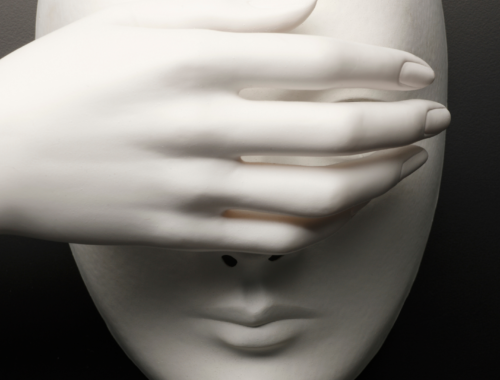
There’s a kind of abandonment that has no name in family conversations. It’s not absence — the body is there. It’s not indifference — the love exists. It’s something more subtle and more destructive: presence emptied of itself.
The child who talks about their day and notices, mid-sentence, that their parent’s eyes have drifted somewhere else. The child who learns, without anyone saying a word, that adults are always somewhere else — and that they shouldn’t interrupt. The partner who stops telling stories because they realized they were arriving somewhere empty.
No one chooses this. No one wakes up and decides to be absent from the people they love. It happens gradually, in secret, while the internal system is too busy surviving to notice what’s being lost.
And what’s lost isn’t time. Time is recoverable. What’s lost are moments — and moments, unlike meetings and reports, don’t get a second call.
Your child’s childhood won’t pause while you handle the next demand. The relationship you’re in won’t wait, with infinite patience, until you finally show up whole. The people around you learn to live without your real presence — and when you finally arrive, they may no longer know where to put you.
The Most Expensive Lie in the Corporate World
There’s a belief that circulates in organizations with the authority of a law of physics: pressure produces results. Demanding more is the language of performance. Those who rest are falling behind.
That belief is wrong. And it’s destroying the companies that practice it.
Think about the manager who approved the wrong proposal on a Monday morning. Not because they were incompetent — they had ten years of experience in that market. They approved it because they’d slept four hours for the third consecutive day, because the previous meeting had run twice as long as planned, because an exhausted brain, faced with a complex decision, found the shortest path available: the one of least immediate effort. The mistake was costly. And no one connected the cost to the cause.
That episode repeats itself, with variations, in offices, clinics, construction sites, schools — wherever human beings make decisions while operating at their limit. The problem isn’t bad will. It’s an architecture that treats the human limit as an irrelevant variable.
There’s something cruel about this dynamic: the organizations that demand the most productivity are often the ones that destroy it most thoroughly. And some professionals themselves have learned to defend this system — because the identity built around the impossible schedule, the “I don’t have a free minute”, the veiled pride of always being at the limit has become, perversely, a marker of value.
Being busy became a way to exist. And existing any other way — present, rested, whole — became almost an audacity that needs to be justified.
Sleep Is Where You Rebuild — or Fail To
Most people know they sleep badly. What most don’t know is what exactly is being lost while sleep doesn’t come or doesn’t repair.
Sleep is not a pause. It’s the only time the body consolidates what it learned, processes what it felt, rebalances what tension dysregulated. Every night of fragmented or insufficient sleep is a night that process doesn’t happen — or happens halfway. And the person who wakes up is not the same person who would have woken up with full recovery: they are a slightly more reactive, less creative version of themselves, less capable of regulating their own emotional state.
The mental marathon that begins when your head hits the pillow — that nocturnal rumination running through unanswered emails, conversations that went wrong, lists that don’t end — isn’t weakness. It’s the portrait of a system that was kept in a state of alert for too long and simply didn’t receive the instruction to switch off. The body lies down. The mind is still at the office.
And the cycle closes with cruel perfection: exhaustion worsens emotional regulation, which worsens sleep quality, which deepens the exhaustion. There’s no natural bottom. There’s only deliberate interruption.
When Anxiety Stops Being a Signal and Becomes the Landscape
Anxiety was designed to be brief. It’s a signal — intelligent, useful, necessary — that something requires immediate attention. The heart accelerates, thinking focuses, the body prepares to act. Once the situation is resolved, the system returns to balance.
What has happened over the past decades — and what hyperconnectivity accelerated without creating — is something else entirely: anxiety stopped being a signal and became the landscape. There’s no longer a specific situation generating the state of alert. The state of alert is the situation. It’s the default mode. It’s the background against which everything else happens.
Every notification that arrives is a micro-urgency. Every professional WhatsApp silence is an ambiguous threat. Every end of the workday carries the doubt about what was left undone. The constant availability that technology made possible gradually became an expectation — and then an unwritten demand, perfectly understood by everyone.
The result is a generation that is technically functional and inwardly exhausted. That responds, delivers, shows up, smiles when required. And that operates, day after day, with a minimal fraction of its real cognitive and emotional capacity.
Not because it’s incapable. Because the fuel ran out long ago — and no one noticed, not even them.
Rest Is Not the Opposite of Work — It’s Its Condition
Rest is not a reward. It’s not the prize for those who finish everything. It’s the biological, cognitive and emotional condition for anything that requires thought, creativity, judgment or relational presence to be possible at all.
A rested professional and a chronically exhausted professional may hold the same position, the same résumé, the same intention — and not be the same professional. The quality of thinking changes. The ability to see what isn’t obvious changes. The capacity to genuinely listen to another person — rather than just waiting for your turn to speak — changes. The tolerance for ambiguity, which is the heart of any difficult decision, changes.
Protecting rest, in that sense, is not an act of self-indulgence. It’s an act of responsibility — toward the work itself, toward the people who depend on the quality of that work, toward the relationships that deserve the whole presence of those who inhabit them.
And here the question becomes necessarily collective. Because it’s not enough for individuals to understand this if organizations continue to be structured on contrary premises — if the environment punishes rest with additional overload, with veiled guilt, with the implicit narrative that those who stop are those who don’t care enough.
When a company treats human recovery as an operational detail, it isn’t being demanding. It’s being shortsighted. Because the human being who walks through the door every morning isn’t a function — they’re a person. And people who cannot recover don’t deliver less. They stop delivering who they really are.
What Doesn’t Come Back
There is a possible recovery. That’s real and needs to be said: when the organism receives the right conditions — structured support, restored sleep, reorganized demands — it responds. Focus returns. Motivation resurges. The capacity to find pleasure in what one does, which had vanished so gradually that the person hadn’t even registered its departure, reappears.
But not everything recovers at the same pace. And some losses, when prolonged too far, don’t recover at all.
The child who grew up alongside an adult who was physically present and emotionally absent carries marks that no corporate wellbeing program will undo. They learned something about the world — that adults are always elsewhere, that they shouldn’t take up too much space — and that learning doesn’t get erased by a conversation. The relationship that was sustained for years on emptied presence may not have, after individual recovery, the ground needed to rebuild itself. Because the other side also learned to live without you. And sometimes that learning is final.
Time lived in survival mode is not just lost productive time. It’s lost life. Moments that existed and weren’t inhabited. Conversations that happened and weren’t heard. People who were there and weren’t found.
And life’s time, unlike the fiscal quarter, has no retroactive recovery.
The Question That Remains
At the end of the day, when the noise stops — who is there?
If the answer comes too quickly — “I’m fine”, “managing”, “that’s just how it is” — perhaps it’s worth staying a little longer with the question. Not to catastrophize. But to practice something that survival mode systematically erodes: the capacity to notice. To observe, honestly, the difference between functioning and living.
Because the crisis the data reveals is not only a crisis of exhaustion. It’s a crisis of presence. A crisis of contact — with oneself, with those one loves, with the work that once had meaning.
And crises of presence are not solved by more efficiency, more discipline or more willpower. They are solved by the courage to stop long enough to find yourself again.
To rest, in this context, is not weakness. It’s the most radical act available to anyone who still wants to have something real to offer — to themselves, to the people they love, to the work they chose.
The problem is not that we are exhausted.
The problem is that we are exhausted and convinced that this is the most we can ever be.
It isn’t.
P.S. If this text touched something you didn’t know how to name, the path continues at www.marcellodesouza.com.br — hundreds of articles on what moves, immobilizes and transforms human beings inside and outside organizations.
#survivalMode #professionalBurnout #mentalHealth #mentalHealthAtWork #presenteeism #leadership #corporateWellbeing #humanDevelopment #selfAwareness #consciousLiving #marcellodesouza #marcellodesouzaoficial #coachingevoce
Marcello de Souza | Coaching & Você
marcellodesouza.com.br
© Todos os direitos reservados
Se isso fez sentido para você, existe um próximo passo possível
Algumas reflexões não terminam no conteúdo — elas continuam em forma de diálogo, aprofundamento ou sustentação de um trabalho contínuo.


PRESENTE EN TODO. AUSENTE DE SÍ.
Você pode gostar
HAVE YOU EVER LOVED SOMEONE WHO ONLY EXISTED WHEN THEY WERE SUFFERING?
THE SQUARE THAT DID NOT APPLAUD