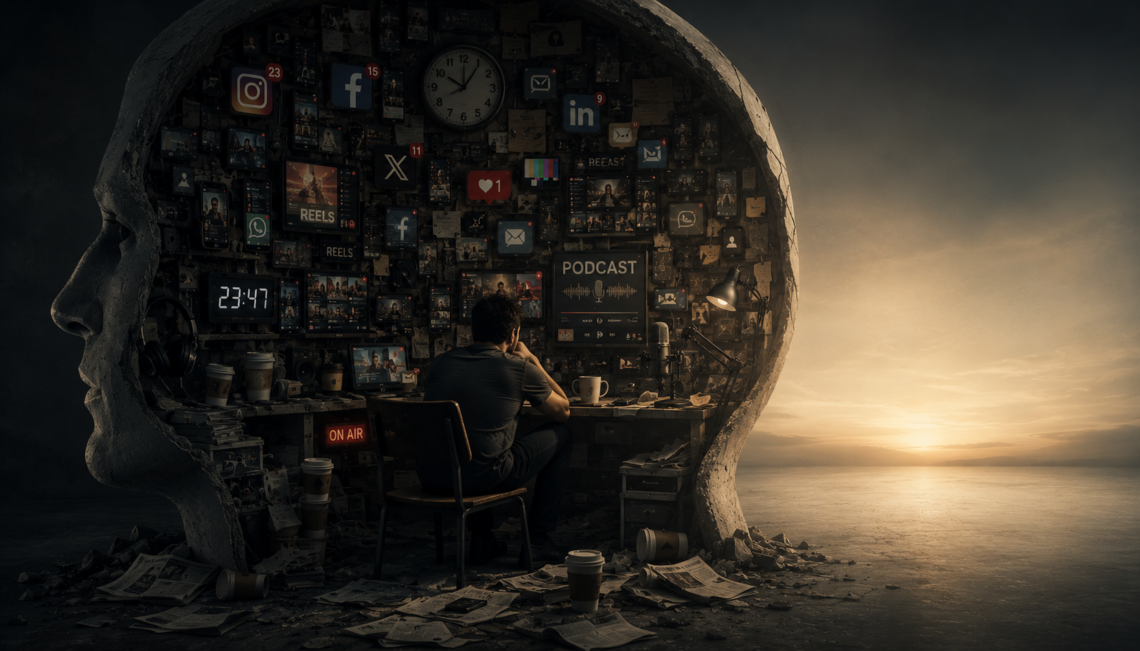
WHEN YOU STOP, WHAT REMAINS?
There’s something I never hear anyone admit out loud, but I’m absolutely convinced that almost everyone feels it at some point: the fear of being alone with themselves.
Not the fear of loneliness. That’s different. Everyone knows that one, talks about it, has a name for it. I’m talking about another kind of fear — the one that shows up when the apartment goes quiet, when the calendar finally opens a gap, when nobody needs anything from you, no notification, no meeting in forty minutes. That specific fear of just being there, still, with nothing to do, and suddenly realizing you don’t quite know what to do with yourself.
This fear has no elegant name. It never became the theme of a motivational keynote. It has no hashtag. But it’s everywhere — just disguised as something else.
It’s the person who turns on the television the moment they get home, not because they want to watch anything, but because the silence is uncomfortable. It’s the guy scrolling his feed in loops at 11pm, not looking for anything, just… postponing. It’s the woman who always has a podcast playing — in the bathroom, the kitchen, the car — because silence, without her having noticed yet, has become unfamiliar territory.
I’ve been that person. And still am, on certain days. And that’s not a confession of weakness — it’s just honesty about how the mind works when it’s been trained its entire life to produce, to respond, to be available, to be useful. Silence doesn’t come naturally to those shaped by urgency. It has to be learned. Almost relearned, actually, because at some point in childhood we knew how to do it — we knew how to stare out a window for no reason, how to play without purpose, how to exist without justification. And we lost it gradually, as the world demanded more and more productive presence and less and less simply human presence.
What strikes me most isn’t the fact itself — it’s that we’ve built an entire life around never having to face that fear. With impressive competence. With a creativity that, directed elsewhere, would probably be genius. We invented a thousand ways to never have to sit in silence with ourselves. And called all of it productivity. Engagement. Digital presence. Networking. “Staying current.” And we believed it — because it’s far more comfortable to have a full calendar than to sit with yourself and answer questions that have no easy answers. It’s simpler to be needed by others than to discover what you need from yourself. It’s more elegant to be busy than to be honest.
Before anyone thinks I’m proposing a spiritual retreat or a meditation methodology — I’m not. I’m proposing something harder and simpler than that at the same time. I’m proposing that you look at the noise you manufacture and ask yourself: what, exactly, does it protect you from?
Because the noise protects. That’s the point almost nobody says out loud.
We talk about silence as if it were absence — lack of sound, lack of stimulation, lack of occupation. But silence isn’t the lack of anything. It’s the presence of everything you didn’t want to look at while you were busy. It’s the moment when the questions you’ve been pushing to tomorrow, to after the holidays, to “when things calm down,” show up in front of you without asking permission.
And those questions aren’t pretty. They’re not the kind with answers you find at a weekend workshop.
Questions like: “Am I living the life I chose, or the one that happened while I was in a hurry?” Questions like: “Do I still know what makes me feel alive, or do I only know what keeps me occupied?” Questions that, if you’re honest enough not to answer them with the first thing that comes to mind, will hang in the air for a long, uncomfortable time. And that’s exactly the discomfort we avoid. With mastery. With years of practice.
When was the last time you went for a walk without earphones? Not an exercise walk with a motivational playlist and a step counter. A walk with no purpose, no metrics, no task being completed. Just you, your feet on the ground, and whatever comes.
If the answer is “a while ago,” you probably also can’t remember the last time you had a thought that was genuinely yours — not a reaction to something you read, not an extension of a conversation you’re still processing, not an echo of the last content you consumed. A thought that was born from space. That wouldn’t have arrived if you’d been filling every second with input.
Because the deepest thought you’re capable of having doesn’t compete with the noise. It doesn’t shout. It waits.
And if you never give it space — it keeps waiting. Sometimes for a lifetime.
This is where I need to be careful, because I’m approaching terrain that easily becomes cliché. So let me say it differently: I’m not talking about enlightenment. I’m not talking about inner peace as a final destination. I’m talking about something far more concrete, more everyday, more urgent than that.
I’m talking about being able to hear yourself.
Not the self that automatically answers “how are you?” with “busy but good.” Not the self that knows exactly which version to present in which context. I’m talking about what exists before all of that. What remains when you remove the performance layer. What’s left when nobody is watching and there’s nothing to prove.
That self — do you know it?
In the conversations I have, I notice that many people arrive at a certain point in life with an extraordinary competence for functioning in the world and an impressive difficulty functioning with themselves. They know how to delegate. How to present results. How to motivate teams. How to be the right son or daughter, the present spouse, the reference professional. And one day, usually in a circumstance they didn’t choose — a forced pause, a loss, an illness, a layoff, anything that breaks the rhythm — they find themselves facing themselves and realize they don’t quite know who they are when they’re not being useful to someone.
That is the cost of permanent noise. Not distraction — dissociation.
We drift from ourselves without noticing, gradually and almost imperceptibly, precisely because the process has all the appearances of progress. You’re growing. You’re learning. You’re building. And you are — only you’re also running, at the same time, with an elegance that fools even you. And the problem with this particular escape is that it doesn’t hurt immediately. It hurts later. It hurts when you stop. It hurts when life stops you. It hurts in that instant when the noise gives way and you realize that for a long time you haven’t known who lives beneath everything you do.
I’ve seen this happen with people I deeply admire. Competent, accomplished, respected people. People who built solid careers, raised children, maintained marriages, accumulated experiences most people will never have. And who, at some point — sometimes in a crisis, sometimes on an ordinary morning with no apparent reason — looked inward and felt a strangeness they couldn’t name. As if the person inhabiting everything they’d built were, somehow, distant. Familiar in outline, unknown at the center.
This is where I need to speak about something I see repeatedly in Cognitive Behavioral Development sessions — and that rarely gets named with the precision it deserves.
Loneliness.
Not the loneliness everyone talks about. Not the one that became the subject of congressional hearings, scientific papers, alarming statistics about the generation most connected and most alone. That loneliness already has its spotlight. Its campaigns. Its apps promising a fix.
I’m talking about another kind. A loneliness that doesn’t show up in indexes because it isn’t measured by the absence of company. It’s measured — when someone has the courage to measure it — by the distance between you and yourself.
I see this in sessions with a frequency that still surprises me, after all these years. The person arrives functional. Articulate. Sometimes even cheerful. They talk about goals, challenges, relationships that aren’t working, work that consumes too much. And at some point — usually not in the first session, sometimes not in the first three — something gives. Not dramatically. Almost in silence. And what appears beneath all that articulation is a person who, surrounded by everything and everyone, can’t remember the last time they felt at home inside themselves.
Not alone in the world. Alone from themselves.
And that distinction changes everything. Because the loneliness that comes from the absence of others has an obvious remedy — connection, presence, bond. The loneliness that comes from the absence of yourself doesn’t get solved by company. It gets solved by silence. By stopping. By the kind of encounter no calendar accommodates, because it requires you to give up, even for a few minutes, being useful to someone.
It requires you to simply be — for yourself.
And that’s where noise reveals its deepest function: it isn’t just distraction. It’s anesthesia for a loneliness most people don’t even know they’re carrying. A silent, sophisticated loneliness, perfectly disguised as a full life.
Then silence arrives. One way or another, it always does.
Sometimes you choose it. Sometimes it’s imposed. I prefer to talk about the silence you choose — the imposed kind carries a different weight, a different violence, and deserves another text. The silence you choose, even for five minutes, even with discomfort, even without knowing what you’re looking for, has a specific quality: it’s voluntary. And what is voluntary has a chance of being gentle.
What happens in those five minutes isn’t meditation, isn’t an immediate insight, isn’t a spiritual revelation. What happens is far more mundane — and for that reason, far more real: you begin to notice how much noise you carry inside yourself that has no external origin. How much of the chaos you attribute to the world around you is, in fact, chaos you brought from within. How much of the agitation you feel isn’t a response to the environment — it’s your natural operating state, normalized so long ago you no longer recognize it as agitation. It’s your baseline. It’s what you call normal.
Recognizing that — without hurrying to fix it, without methodology, without expected results — is already something. Maybe it’s everything.
I distrust words that have grown too large for what they describe. “Self-knowledge” is one of them. Not just because of the wear — because of the assumption it carries hidden inside. When we talk about knowing ourselves, we assume, almost always without noticing, that there’s a fixed self to be known. That beneath all the layers of adaptation, performance, accumulated roles, there’s something solid and original waiting to be found. The true self. The authentic self. The one that was there before everything and will remain after.
Only I’m not so sure that’s true.
Because when you stop — really stop — what appears isn’t necessarily clarity. It’s multiplicity. It’s the version of you that existed before your career and the version your career created, both looking at each other without knowing which one has more right to the name. It’s the you from twenty years ago who wanted something completely different, and the you of today who learned to want what you have. It’s the you who shows up with your children and the you who appears alone at three in the morning unable to sleep — and those two barely recognize each other.
So self-knowledge of whom, exactly?
Which version of you? The one your parents would recognize? The one your colleagues know? The one that exists when you’re in love? The one that emerges when you’re angry? The one that appears in silence — which may be just one more version, not necessarily the most true, only the least rehearsed?
Maybe the question isn’t to find the true self. Maybe it’s to learn to sit with all of them at once, without needing to elect one as the official version. Without needing to resolve the contradiction. Without needing to choose which version of you deserves to continue.
Silence doesn’t reveal who you are. It reveals how many you are.
And that — depending on the day — can be the most liberating or the most frightening thing you’ve ever faced.
Living from the outside in is letting the world decide which version of you shows up today. It’s waking up and being shaped by what arrives — the notification, the demand, the mood of whoever is beside you, the urgency of what can’t wait. It’s not weakness. It’s the default mode. It’s what happens when you’re not present enough to choose.
Living from the inside out isn’t different because you found the true self. It’s different because you know, at least in that moment, which of your versions you’re choosing to bring forward — and why. It’s not the absence of contradiction. It’s conscious contradiction.
And that’s only possible when you stop long enough to hear the internal conversation happening all the time, beneath the noise, between all the versions of you that exist simultaneously.
Simple. Difficult. And the contradiction, as we’ve already said, is part of the deal.
I have no method to offer. I distrust methods for silence — they are, most of the time, just another sophisticated form of organized noise, with a nice name and instructions for doing it correctly. What I have is a provocation. One. Direct. No layers:
Today, at some point — before sleeping, before picking up your phone in the morning, in the gap between one meeting and the next — be quiet for long enough to feel slightly uncomfortable. Not because discomfort is virtuous. Not because there’s a guaranteed reward on the other side. Simply because if it doesn’t unsettle you a little, you’re probably still on the surface. Still managing silence instead of inhabiting it. Still turning silence into one more well-executed task.
And what you’re looking for isn’t on the surface.
It’s in the place the noise hasn’t reached yet. The place you protected without realizing it, muffling it with occupation, content, urgency. It lives in the part of you that never needed external validation to exist — and that’s still there, quiet and stubborn, waiting for you to remember it does.
Will you remember?
And if the answer, for today, is no — that’s fine. That too is data. Honest data about where you are, not a verdict on who you are. Silence doesn’t charge. It simply waits. With a patience that, honestly, should humble us a little. And the difference between the people who one day find themselves and those who never do isn’t talent, isn’t time, isn’t circumstance — it’s the willingness, at some moment, to stop avoiding the encounter.
Silence is not a universal experience. For some, it’s an abyss; for others, a refuge. But even among those who fear it, that fear doesn’t arise from the individual alone — it’s shaped by streets that never stop, screens that never go dark, and an economy that teaches us to dread emptiness. And perhaps, before thinking about silence, we need to feel it: in the shoulders that drop, in the breath that slows, in the foot that touches the ground without hurry. Because silence isn’t an idea — it’s a body learning to be.
If this text touched something you hadn’t yet named, you’ll find hundreds of others in the same register — dense, honest, without shortcuts — at marcellodesouza.com.br. That’s where this conversation continues, with the depth it deserves.
#innersilence #selfawareness #humandevelopment #presence #identity #behavior #consciousness #consciousliving #marcellodesouza #marcellodesouzaoficial #coachingevoce
Marcello de Souza | Coaching & Você marcellodesouza.com.br © All rights reserved
Se isso fez sentido para você, existe um próximo passo possível
Algumas reflexões não terminam no conteúdo — elas continuam em forma de diálogo, aprofundamento ou sustentação de um trabalho contínuo.

QUANDO VOCÊ PARA, O QUE FICA?
CUANDO TE DETIENES, ¿QUÉ QUEDA?
Você pode gostar

HOW TO FIND CLARITY WHEN YOU DON’T KNOW WHAT YOU WANT

YOU TRAINED THE LEADER. WHY DO THEY KEEP BREAKING?
