THE NIGHT I STOPPED THINKING AND DISCOVERED I HAD NEVER BEEN THINKING AT ALL
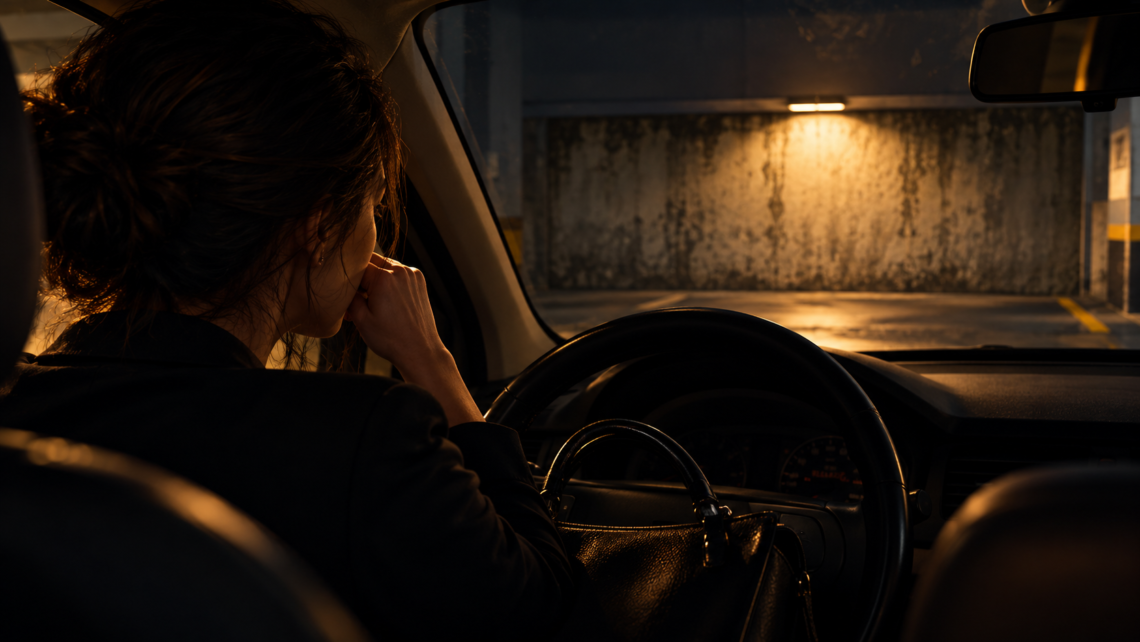
One day, a client walked into our session and, before she had even settled into her chair, told me that the previous Tuesday, at almost eleven at night, she had switched off the engine in her building’s garage and never gone upstairs.
For nine days she had been carrying the same question. A company in another city had offered her the position she had worked toward her entire life, with a different salary, with everything that, at twenty-five, she would have called a dream. All she had to do was say yes by Friday.
In those nine days she did what any sensible person would do. She built a spreadsheet with moving costs and schools for her son. She talked it over with her husband three times, and two of those conversations ended in silence in the kitchen. She called a former boss, her sister, a friend who had been through something similar. She read about the new city until she knew the names of its neighborhoods by heart. She woke at four in the morning with her mind already running, redoing sums that never changed.
That Tuesday, sitting in the dark car with her bag on her lap and her phone face down, she was no longer thinking about anything. She was too tired for that. And it was there, staring at the stained concrete wall beyond the windshield, that she began to cry. Not a desperate kind of crying. The kind that comes when you finally let go of something.
Somewhere in the middle of it, a sentence arrived, short, almost soundless: “I don’t want to go.”
She told me it felt as if the answer had finally come. Then she paused, looking down at her own hands, before adding: “Except, now that I think about it, I knew on the first day. When the recruiter said the name of the city, my stomach turned.”
That pause stayed with me.
Because she isn’t alone. You have probably lived your own version of that night. Accept or decline. Stay or leave. Tell or keep it to yourself. Days of turning pros and cons over like someone searching the same pocket for the keys a tenth time, knowing they aren’t there and searching anyway. And then, suddenly, in the shower, at a red light, by a window, in tears that never asked permission, something gives way and the answer shows up with a clarity no argument had managed to produce.
We tend to tell that scene as a revelation. I see something else.
I suspect the answer didn’t arrive that night.
It had been there since the first day. In the stomach that turned.
*
Let’s slow down.
A man has spent months trying to decide whether to end a relationship of many years. He talks to friends, revisits the good times, weighs the house they share, the dog, the trips already paid for, her family whom he has learned to love. It looks like a process of choosing. It looks mature, careful, fair.
Now watch his body over that same stretch of time. The sound of the key turning in the lock at the end of the day starts to weigh on him before he even reaches the door. He begins staying late at work for no reason, sitting an extra twenty minutes in the car with a song he didn’t even pick. When she rests her hand on his shoulder on the couch, something inside him pulls back an inch, and he pretends not to notice. Talk of next year’s vacation leaves him strangely short of breath. None of this makes it onto the list of pros and cons. All of it already is a list. A list written in another language, one he hasn’t yet agreed to read.
What I think is that the body votes first. Long before any organized sentence, it has already marked, in a kind of invisible ink, what is bearable and what is not. Every bad memory, every sleepless night, every moment that made us shrink inside left a trace. And those traces quietly add up until they form a direction.
The mind shows up later. Late, out of breath, arms full of paperwork, wanting to chair a meeting whose decision was already made in the hallway.
*
Which brings me to the question that genuinely interests me.
If the decision had already been made, what exactly were we doing all those days?
I’ll risk an answer that isn’t pretty: we were negotiating. Not with the problem, with ourselves. We spent days trying to find a way not to have to know what we already knew.
There’s an everyday name for this, we just never use it. We call it “thinking it through,” “letting the idea mature,” “not acting on impulse.” And sometimes that’s exactly what it is, of course. Some decisions do call for time, information, conversation. Some people need to listen before moving a single piece. There’s another kind of thinking, though, far more common than we admit, that isn’t there to find the answer. It’s there to manage the fear of having found it.
It’s the thinking that spins.
You know it. It keeps circling back to the same point, replaying the same imaginary conversation, reworking the same numbers with a different flavor of optimism each night, asking a third, fourth, fifth person for their opinion in the hope that one of them will say the sentence that spares us the responsibility. It looks like reasoning. It uses the vocabulary of reasoning. It just doesn’t move an inch. Like a car revving with the gearshift in neutral: noise, heat, the smell of fuel, and the car sitting exactly where it was in the garage.
For a long time I believed this spinning was a flaw, an inability to reach a conclusion. Today I think it serves a very precise purpose. It postpones. It buys time so we don’t have to walk through a door that, deep down, has already swung open.
*
And why would we postpone something we already know?
Because knowing sends a bill.
The moment I admit to myself that I want out of this marriage, that I don’t want to have that child right now, that I can’t stand my business partner anymore, that I need to say no to my father, something in the world shifts. I become someone who knows. And whoever knows has to act, or has to live with the awareness of not acting. Both hurt.
While I’m “thinking,” I stand on a kind of neutral ground. I betray no one, disappoint no one, lose nothing. I’m simply a responsible person reflecting calmly. It’s an elegant hiding place. Socially accepted, even admired. Nobody criticizes someone who is “carefully weighing their options.”
In companies, it’s impossible to miss. The manager who asks for one more report on the employee everyone already knows won’t stay. The board that hires yet another consultancy to confirm what the hallway has been saying for two years. The committee meeting for the fourth time to “align” on a decision nobody has the nerve to sign. Entire organizations run like one enormous spinning mind, producing analysis on an industrial scale so they don’t have to feel the weight of what they already know.
And there are couples like that. Families like that. Whole lives like that.
*
Then the night comes.
The person is exhausted. They’ve talked too much, thought too much, listened to too much advice. The body simply can no longer sustain the effort of keeping the negotiation open. And right there, precisely when the capacity to resist runs out, the answer appears.
We read this as if exhaustion had opened a channel to some hidden wisdom. I see it differently. Exhaustion didn’t open any channel. It knocked out the doorman.
For days, someone inside us stood at the door, clipboard in hand, blocking a piece of information that had been waiting in line from the very beginning. When that doorman falls asleep on his feet, the information simply walks in. Not because it became any truer. Because nobody had the strength left to stop it.
That’s why these resolutions come with tears and relief, almost never with euphoria. The relief doesn’t belong to someone who discovered something new. It belongs to someone who has finally stopped holding a heavy door shut.
Have you noticed that when the decision “arrives,” it usually carries a strange taste of recognition? It doesn’t sound like “wow, what an idea.” It sounds like “yeah, I know.” Like running into someone you’ve known for years on a street you’ve never walked before. There is surprise, yes. It’s the surprise of reunion, though, not of discovery.
*
Here I need to be suspicious of myself.
Because this story, told this way, risks becoming one more comforting fable: the body knows, trust your body, the answer is inside you. And honestly, that bothers me as much as the opposite fable, the one that says you only need to think well to decide well.
The body does vote first. The body also votes with everything that has ever hurt it.
A woman who grew up in a house where raised voices ended in violence may feel, in the face of any conflict, a tightness in her chest that says “get out of here.” That tightness is real, honest, old. It still isn’t good counsel in a work meeting where disagreeing is exactly what’s needed. A man who learned early that being left is the worst thing in the world may feel an enormous calm when he decides to stay in a relationship that diminishes him every single day. The calm doesn’t prove the choice is good. It only proves the choice avoids the pain he fears most.
The sense that something “feels right” carries no guarantee of truth. It carries the signature of our history. Sometimes that history is wise. Sometimes it’s just frightened.
And the most unsettling part is that, on the inside, the two can taste exactly the same.
*
So if I can’t blindly trust my mind, and I can’t blindly trust my body either, where does that leave me?
It leaves me with a different question.
All our lives we’ve learned to ask “what should I decide?” I’d suggest that the more honest question, nearly always, is another one: “what have I already decided that I still haven’t had the courage to look at?”
It seems like a small swap. It isn’t. The first question puts us in front of a menu, as if every option were equally available, waiting for an impartial customer. The second puts us in front of a mirror. It starts from the premise that there is already an inclination underway, a direction the body and memory have been sketching for a long time, and that the work isn’t to invent a choice but to examine the one already in motion.
Examining, in this case, doesn’t mean obeying.
It means asking where it comes from. Is this urge to leave born from what this place is today, or from what similar places were for me in the past? Is the peace I feel about staying the peace of someone who is home, or the peace of someone who dodged a scare? Is the “yes” that slips out of me when I think about the offer desire, or an escape from something that has nothing to do with the offer at all?
These questions don’t spin. They sink. And there’s a physical difference between the two that anyone can recognize when paying attention: the thinking that spins wears you out and leaves your mouth dry; the thinking that sinks hurts, sometimes a lot, and afterward leaves a kind of space.
*
I like to think of a very ordinary image for this.
The line at the bank, back when everyone still had to go to a branch. You walk in, take a number, sit down. You look at the display. Forty numbers to go. You know it will take a while, you know exactly how long, and still you check the display every thirty seconds, stand up, feel for the ticket in your pocket, ask the person next to you if the line is moving, complain, calculate, get irritated. None of that agitation changes the number that will be called. It only gives the body the feeling that it’s doing something while it waits for what it can’t control.
Much of our “reflection” on difficult decisions is exactly that: watching the display. The number is already printed on the ticket in our hand. We know what it says. We keep staring at the display because looking at the ticket would mean accepting our turn when it comes.
And it always comes.
*
There’s one more layer almost no one talks about.
When we finally admit a decision, we rarely gain only a direction. We also gain a loss to mourn. Deciding means, inevitably, burying the versions of ourselves that won’t happen. The person who stays in the job buries the one who would have taken the risk. The one who leaves buries the one who would have built a long career at that company. Whoever ends the relationship buries the future imagined with that person, the children they might have had, the old age agreed upon in Sunday conversations.
I believe much of the mental spinning is a refusal of that burial. As long as I don’t decide, I keep every version of myself alive, all of them possible, all of them pending. I’m rich in futures. The decision suddenly makes me poorer, leaves me with a single life, a single line, with every loss that implies.
Seen this way, postponing makes an almost tender kind of sense. It isn’t laziness or cowardice. It’s attachment to possibility. It’s the difficulty of giving up being everything in order to accept being something.
The price of that attachment is high, and it’s silent. While I keep every version alive in my head, none of them actually lives in the world. I stand on the platform admiring every train, and board none.
*
Maybe right now you’re thinking about one specific decision. The one that has been circling for weeks, months, maybe years. The one you’ve explained to so many people that the explanation has worn thin, its edges rounded from use.
I don’t know what it is. And I won’t pretend to know what you should do with it.
I only want to offer an exercise in honesty, the kind no manual includes. The next time your mind starts to spin, try to notice the exact moment when the thinking stops searching and starts protecting. There’s a point where it changes texture. It turns repetitive, anxious, slightly theatrical, as if performing for an invisible audience that needs to be convinced you’re a sensible person.
At that point, stop.
Not to find the answer. To ask, as simply as you can, which sentence you’re avoiding saying out loud. Often it has four or five words. “I don’t want this anymore.” “I want to try.” “I’m afraid of him.” “I don’t love this job.” “I’ve already left.”
Say that sentence, even if only to yourself, in the car, with the windows up.
Then notice what happens in your body. If relief comes, look at it carefully. If panic comes, look even more carefully. Neither one decides for you. Both tell you where you’re starting from.
*
I go back to my client, to the car parked in the garage, to the unexpected tears.
For a long time I too would have read that moment as an epiphany. Today I see it as an appointment made long ago, one that someone inside us kept canceling with ever more sophisticated excuses. No answer fell from the sky. There was a person too tired to keep pretending she was still looking.
And perhaps the most serious question that scene leaves behind isn’t “how do I get to the right answer faster?” Perhaps it’s something more uncomfortable, more intimate.
How many more nights will you need to wear yourself out before you allow yourself to know what you already know?
What if, next time, you didn’t wait for exhaustion to knock out the doorman?
What if you simply walked to the door, while you still have the strength, and opened it with your own hands?
On the other side, it will probably be getting dark.
And you’ll recognize the view.
If these questions stirred something in you, keep the conversation going at marcellodesouza.com.br, where I’ve gathered hundreds of articles on human and organizational cognitive-behavioral development and on healthier, more conscious human relationships.
#difficultdecisions #decisionmaking #humanbehavior #selfdeception #choices #humandevelopment #leadership #humanrelationships #marcellodesouza #marcellodesouzaoficial #coachingevoce
Marcello de Souza | Coaching & Você
marcellodesouza.com.br
© All rights reserved
Se isso fez sentido para você, existe um próximo passo possível
Algumas reflexões não terminam no conteúdo — elas continuam em forma de diálogo, aprofundamento ou sustentação de um trabalho contínuo.


Você pode gostar

WHEN THE POISON COMES FROM WITHIN

FAILING IS EVOLVING WITH COURAGE: THE NEUROSCIENCE OF FAILURE AND THE REBIRTH OF THE AUTHENTIC SELF