WHO VOTES WHEN YOU VOTE?
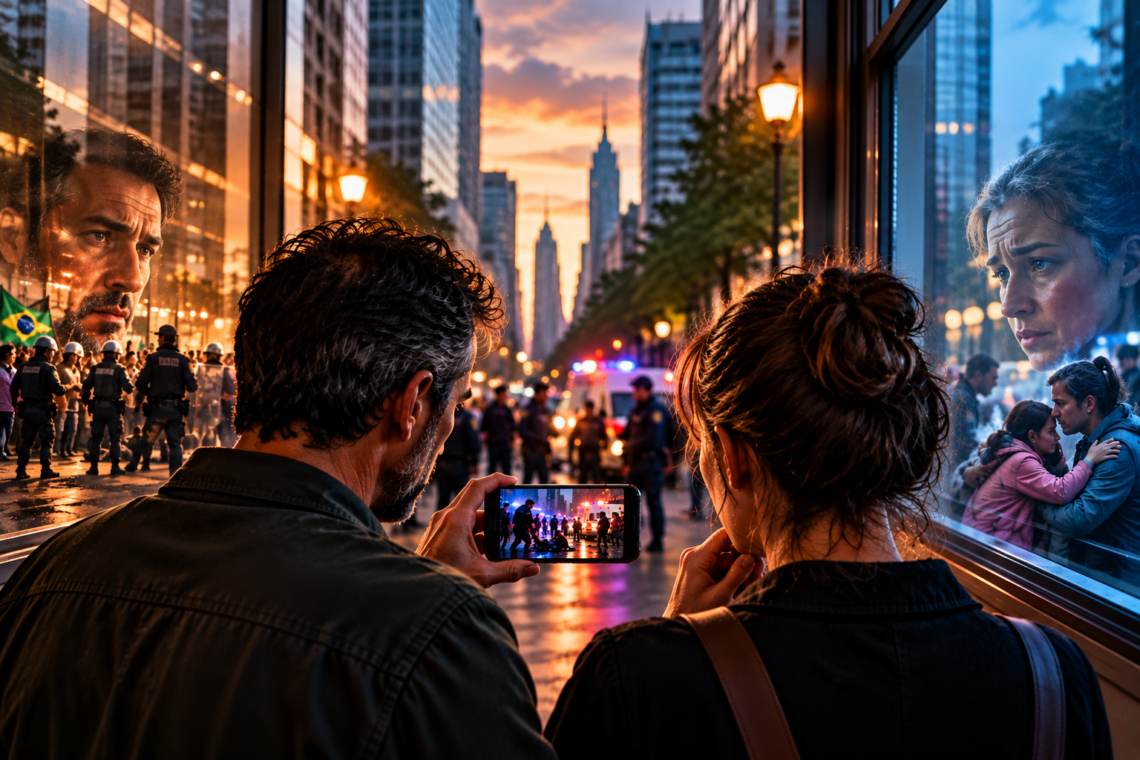
Sunday, after lunch. Dishes still in the sink, someone dozing in the armchair, and a phone passing from hand to hand until it lands on the couch where you and your brother-in-law are sharing the same stretch of cushion. A forty-second video. People crossing a border at night, a child on someone’s hip, a patrol car, a uniformed man shouting something the audio won’t quite let you make out.
He sees an invasion.
You see desperation.
Or the other way around. I’m deliberately not saying who’s who, and I’d ask you not to decide yet either. Stay a moment in that discomfort. These lines need it.
The forty seconds end. Both of you get up from the couch convinced the other is twisting what was right there on the screen, in plain sight. One asks whether the other even saw the child. The other fires back, asking whether he bothered to count how many there were. Nobody lied. What happened in that living room is stranger and more serious than a lie: two people, shoulder to shoulder, honestly witnessed two different facts. They watched the same video and still weren’t in the same place.
*
Not long ago, researchers did something very much like that Sunday, only with more rigor and fewer cushions. They placed people from opposite ends of the political spectrum inside one of those machines that track the brain at work in real time, and showed all of them the same videos about immigration. Speeches, news reports, campaign ads. Material made to measure for getting under someone’s skin.
The expectation was to find the obvious: some region glowing brighter on one side, some structure bulkier on the other, a kind of ideological birthmark. None of that showed up. Something else did, and it cost me a few nights of sleep. When they compared how each person’s brain activity rose and fell over the course of a video, second by second, conservatives looked remarkably alike. Progressives looked remarkably alike too. And the two groups drifted apart precisely in an area that isn’t in charge of seeing or hearing. It’s in charge of stitching. It’s the part that turns whatever comes in into a story, that decides what comes first, what counts as cause, what’s mere detail, who the villain is and who deserves our pity.
The eyes took in the same light. What changed was the narrator.
I could stop here and turn this into one more proof that the other side came with a factory defect. It would be comfortable, and it would be false. What unsettles me about the finding isn’t the difference between the groups. It’s the sameness within them. Each person in that machine was alone, lying still, talking to no one, believing, as we all believe, that they were forming their own opinion. And their brain was rising and falling at the very same moments as the brains of strangers who thought alike, people they’d never met and may never meet.
We think we think alone. We almost never do.
*
There’s a temptation to ask whether this comes from nature or nurture, from what we inherit or what surrounds us. It’s an old question, and the answer lets down anyone looking for a shortcut: it’s all of it, all at once. We’re born with a temperament. Some more alert to danger, others more curious about the new; some who flinch at a knock on the door, others who rush to see who’s there. That’s real, and it isn’t small. Temperament is a lean, though, not a destiny. What turns a lean into a conviction is use.
The brain doesn’t keep what’s true. It keeps what’s traveled.
A dirt path across a field isn’t born from any plan. It’s born from feet. Someone crossed once because it was shorter, someone else crossed because they saw the mark, and within a few months the grass gave up growing there. A year later nobody remembers there were other ways across; the path looks natural, almost a law of the landscape, and whoever walks off it looks lost. The connections between our neurons follow a similar logic. Whatever gets crossed every day becomes a paved road, fast, automatic, effortless. Whatever never gets crossed goes back to brush.
How many times since you woke up today have you been outraged by the same thing?
The clip the algorithm served you at seven in the morning. The voice note in the family group chat at eleven. The headline a coworker shared at lunch. The comment you read and didn’t answer, except you did answer it in your head, word for word, while brushing your teeth. Every outrage is one more step down the path. And the brain can’t tell rehearsal from belief. The same anger rehearsed three hundred times stops being a reaction and becomes a way of seeing. You no longer need to think in order to get angry: the anger arrives ready-made, before the thought, and the thought shows up afterward in a suit and tie to sign off on a decision that had already been made.
That’s why I’m so wary of the phrase “I’ve made up my mind.” Made up by whom? Over how many sessions? With what material? In a course you chose, or in a curriculum someone else built for you while you scrolled in the bathroom?
Whatever you keep repeating votes on your behalf. Long before election day.
*
There’s a layer that almost never enters political arguments, and to my mind it explains more than any party platform.
Loss.
Every political position is, among other things, a way of dealing with what was lost or with the dread of losing it. Some people lost a country they remember: the street where kids played until dark, the job that gave a father a name and a seat at the head of the table, the full pews on Sunday, the sense that the world had rules everyone knew and kept. That person looks at the future the way you watch over what’s left of a house after a storm. And some people lost what they never got to have: the opening that never came, the neighborhood that was never paved, the respect nobody gave the grandmother who spent her life cleaning other people’s homes. That person looks at the past the way you look at a bill still waiting to be paid.
Both are grieving. For different things, in different tenses.
And grief doesn’t yield to statistics. Anyone who has tried to comfort someone at a funeral with an argument knows what I mean. When a chart contradicts someone’s fear, they don’t feel they’ve received information; they feel someone just stepped on a grave. Our minds weigh the threat of losing far more heavily than the promise of gaining. The same banknote, dropped on the way home, hurts much more than it delights when you find it on the sidewalk. In politics, that imbalance becomes fuel. Whoever speaks to your fear of losing speaks louder than whoever speaks to your hope of gaining, whichever side, whichever year.
There’s more. When an idea that holds up who we are comes under attack, the body has no idea it’s dealing with an idea. It reacts the way it would to an angry dog at the gate: the heart races, breathing shortens, the field of vision narrows. In the next political argument in your family chat, watch your hands. You aren’t debating. You’re defending yourself. And nobody reasons well with their back against the wall.
There’s also what we do with the things we can’t stand in ourselves. Whatever I refuse to recognize inside my own house, I find with astonishing ease in my neighbor’s. The inconsistency I can’t see in my candidate leaps out at me in the other one, sharp, undeniable, almost glowing. The opponent becomes a screen onto which I pour the piece of me I’d rather not face. And since the screen sits outside, I can hate it without a trace of guilt.
And then there’s family, always family. For many people, changing political positions carries the weight of leaving home. Not the brick-and-mortar one; the other one, the house that lives in the basement of memory. The father who voted a certain way, the mother who prayed for certain causes, the uncle who was the voice of reason at Christmas. Voting differently from them can feel, down there where we rarely go, like betrayal. A great many votes are letters of loyalty addressed to someone no longer alive to read them.
*
This is where the conversation tends to derail, in Brazil and in more places than we’d like to admit.
A conservative is not an extremist. A liberal is not an extremist. A progressive is not an extremist.
Written like that, it sounds obvious. And yet whole countries have unlearned the distinction in recent years. We started calling anyone on the right far-right, with an ease that ought to frighten us, and, across the street, calling anyone on the left far-left, with the same haste and the same laziness. Whoever wants to preserve what works became a suspected authoritarian. Whoever wants to change what doesn’t work became suspected of wanting to tear everything down. Whoever defends the freedom to build a business became heartless; whoever defends a social safety net became a freeloader.
To conserve is a beautiful verb. Anyone who has taken care of an old house knows that not every renovation improves it, and that knocking down a wall without knowing whether it holds up the roof is recklessness, not courage. To progress is a beautiful verb too. Anyone who has opened the window of a room shut for years knows there are things that only get better once air comes in. A healthy society needs those who keep and those who open. Above all, it needs the tension between them, the way a bridge depends on forces pulling in opposite directions to stay standing. A bridge where every force pulls the same way isn’t a bridge. It’s a collapse waiting for a date.
Extremism isn’t a point further along the same line. It’s something else entirely. It begins at the exact moment the other person stops being someone I disagree with and becomes a threat that has to disappear. That can sprout anywhere on the spectrum. And when we confuse the conservative with the extremist, or the progressive with the extremist, we do real extremists an enormous favor: we hide every one of them in the crowd. If everyone different from me is a monster, I no longer need to listen to anyone. Worse, I stop noticing when an actual monster walks in.
*
What nobody tells you is that more education doesn’t fix this.
I wish it did. It would be so much simpler: just inform people, and political polarization would dissolve like sugar in coffee. As it happens, the best-informed people tend to be the most entrenched. The more someone knows, the more skill they gain at defending whatever they believed before they knew any of it. Intelligence, when it works for belonging, becomes a lawyer, not a judge. It doesn’t look for the truth. It looks for ammunition.
I know brilliant engineers, respected doctors, executives who run tense meetings with admirable composure, and who, faced with a forwarded message confirming what they already feel, share it in seconds without checking a thing. Not out of stupidity. Out of thirst. Information that confirms our side doesn’t arrive as data; it arrives as relief. And nobody checks where relief came from.
You can be the world’s foremost expert in a single line of thought and still be hollow as a human being. Knowing a great deal about one thing doesn’t always widen the world; sometimes it narrows it until it fits through a crack. Whoever masters a single lens starts seeing everything through it and mistakes that for clarity. It isn’t clarity. It’s a tunnel, however well lit.
I’m wary of anyone who has never changed their mind about anything important. And I’m just as wary of anyone who changes with every breeze. Between rigidity and slackness there’s a place that’s harder to live in, and it has nothing to do with sitting on the fence. The fence is where people refuse to choose. That other place belongs to whoever chooses knowing what the choice costs, admitting what they give up by choosing and what the other side sees better than they do. A middle way in the most demanding sense possible: not the lukewarm average between two extremes, but the ability to hold two truths in your hands, dropping neither, while you decide.
It takes more muscle than any fanaticism. The fanatic gets by with one arm.
*
There’s another illusion, perhaps the most stubborn of all: that voting is an individual act.
The booth is individual. The finger that presses the button is individual. The vote never was.
It was built at the dinner table, in group chats, in Sunday sermons, in the teachers’ lounge, at the bar after the weekend game, in your mother’s fear of being robbed, in your grandfather’s pride in his first steady job, in the friend who lost everything, in the neighbor whose life got better. Every conversation left a sediment, a thin layer over the one before. We arrive at the ballot box alone, carrying a crowd on our backs.
And the vote doesn’t end with the voter either. It falls on the hospital where a stranger will be treated at three in the morning, on the school attended by the child of someone you’ll never meet, on the company that will open or close the job, on the city that will take someone in or push them out. Individualism is the fantasy that I decide alone and that the consequences stay with me as well. Neither half holds.
Maybe the great confusion of our time is believing that reality sits finished out there, waiting to be seen, and that the problem belongs only to those who see it wrong. Life doesn’t reach us as it is. It reaches us as we build it. Each of us assembles a whole world from the bricks of our own history, our own losses, our own repetitions, and then moves in as if it were the only address there is. Your brother-in-law on the couch doesn’t live in a different country from yours out of stubbornness. He lives there because he built another one, brick by brick, over decades, with the very same tools you used to build yours.
Facts exist. The child on that hip existed. The people crossing the border existed. What changes is the order in which facts get stitched together, the weight each one is given, the question each one is made to answer. And if the reality we inhabit is built, it can be rebuilt. That’s the hopeful part. It’s also the part that takes work, because nobody renovates their own house without raising dust, and without discovering, halfway through the job, that a wall they’d have sworn was load-bearing was only ever decoration.
*
Who to vote for, I won’t say. I have no right to, and no wish to either. The questions that unsettle me most, though, don’t fit on any campaign flyer.
What would I need to see to change my mind? If the honest answer is “nothing,” then what I have isn’t an opinion. It’s belonging. And belonging is legitimate, human, even moving, as long as it’s called by its proper name.
Can I explain the other side’s position so well that someone over there would sign it? Not the caricature circulating in my group chat, but its smartest, most generous, most solid version. If I can’t, I don’t disagree with that position. I disagree with a scarecrow I stitched together myself.
Which loss is voting for me? Which fear? Which old loyalty?
What was the last piece of news that truly made me angry, and who profited from that anger?
When the other person starts talking, what happens in my body before any thought at all?
None of these has a quick answer. Thankfully.
*
Back to that Sunday couch.
The video ends. The phone screen goes dark on its own, and for a moment nobody says a word. Your brother-in-law is already half-rising to get coffee; you’re already polishing the reply you’ll give when he comes back, the perfect line that will finally make him see.
Except that in that second before anyone moves, the black glass of the phone turns into a mirror. And in it appear two faces, side by side, sharing the same dark rectangle, in the same room, under the same roof, with the same dishes waiting in the sink.
Nobody looked.
If this text left a question burning, it has company. On marcellodesouza.com.br you will find hundreds of articles on human and organizational cognitive-behavioral development, and on human relationships that choose clarity over shortcuts. Come in, read, disagree, come back.
#politicalpolarization #elections #humanbehavior #socialpsychology #neuroscience #psychoanalysis #criticalthinking #belonging #democracy #humanrelationships #humandevelopment #marcellodesouza #marcellodesouzaoficial #coachingevoce
Marcello de Souza | Coaching & Você
marcellodesouza.com.br
© All rights reserved
Se isso fez sentido para você, existe um próximo passo possível
Algumas reflexões não terminam no conteúdo — elas continuam em forma de diálogo, aprofundamento ou sustentação de um trabalho contínuo.


¿QUIÉN VOTA CUANDO VOS VOTÁS?
Você pode gostar

THE ABYSS OF LEADERSHIP: THE DANGER OF BECOMING THE MONSTER YOU FIGHT AGAINST

LOVE NEVER ENDS, IT GOES INTO STANDBY